

 30th October, 2026
 CMA- Cost Management Accounting
 Bhagya Achievers
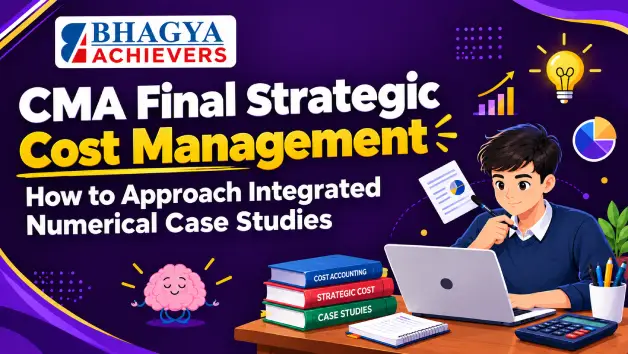
CMA Final Strategic Cost Management: How to Approach Integrated Numerical Case Studies
Table of Contents
One CMA Final Strategic Case Management Case Study can bring several concepts into a single question? So, how can students decide what to calculate first and what information should be ignored?
The Key is not to treat the question as one large problem, Breaking it into smaller requirements, identifying the relevant data and applying the right technique can make integrated numerical case studies much easier to solve.
What are Integrated Numerical Case Studies in CMA Final?
An Integrated Numerical Case Studies is a practical problem that requires more than one concept or calculation.
Strategic Cost Management generally carries 100 marks. Its syllabus is divided into two main sections:
|
Section |
Weightage |
|
Strategic Cost Management for Decision Making |
60% |
|
Quantitative Techniques in Decision Making |
40% |
|
Total |
100 marks |
The syllabus mainly assigns 25% weightage to Decision Making Techniques.
Are Integrated Numerical Case Studies worth 10, 15 or 20 marks?
There is no fixed marking criteria for every case study. Marks mainly depend on the question paper and the performance done by the candidate.
How should students read a Strategic Cost Management Case Study?
In CMA Final Strategic Cost Management, the biggest challenge is not often calculating the answer but understanding what the case study is asking. Students should first understand the business problem, identify the required answer and then, select the correct numerical technique to solve the question.
How to Apply the Correct Technique: Numerical Example
Question: A company receives a special order for 1,000 units at ₹90 per unit. The variable cost is ₹70 per unit. The company has sufficient spare capacity, and accepting the order will not increase fixed costs or affect regular sales. Should the order be accepted?
Step 1: Identify the decision
The company must decide if the special order will be accepted or rejected?
Step 2: Select the correct numerical technique
Students should use the Incremental Analysis, as the decision mainly depends on the additional revenue and additional costs generated by the order.
Step 3: Calculate the incremental benefit
- Additional revenue = 1,000 × ₹90 = ₹90,000
- Additional variable cost = 1,000 × ₹70 = ₹70,000
- Incremental profit = ₹90,000 − ₹70,000 = ₹20,000
Step 4: Write the Conclusion
Students must write the final conclusion after solving the numerical correctly.
Want to Make Your CMA Final Preparation More Strong?
Why do students lose marks in SCM Integrated Case Studies?
Students lose marks in SCM Integrated Case Studies because they know the concept but they do not know how to solve questions in actual examinations. One of the main mistakes done by the student is:
- Students start doing calculations before analyzing the numerical questions.
- They spend 25 minutes on sub-part and leave the rest blank.
- They skipped working notes and did not focus on the main point.
How Should Students Solve Decision-Making Case Studies?
For Decision-Making Case Studies, Students should firstly identify the available alternatives and then compare their relevant costs, revenues and contributions. The following given types are mainly used in Decision – Making Case Studies:
TYPES:
- Make – or – Buy Decision
- Accept or Reject a Special Order
- Product mix under a Limiting factor
- Shut Down or Continue Operating
- Sell Now or Process Further
- Pricing and Profit Planning decisions
- Decisions involving various resources and multiple constraints.
A simple approach must be:
Identify Alternatives → Find Relevant Costs → Calculate Contribution/Profit → Compare → Give Decision
How Students can Solve PERT and CPM Case Studies?
PERT and CPM questions in CMA Final Strategic Cost Management mainly focus on the project planning, activity sequencing and proper time management.
How to identify the Critical Path in CPM: Numerical Example
|
Activity |
Duration |
Immediate predecessor |
|
A |
3 days |
None |
|
B |
4 days |
A |
|
C |
2 days |
A |
|
D |
5 days |
B |
|
E |
3 days |
C |
|
F |
2 days |
D, E |
Step 1: Identify the possible paths.
- Path 1: A → B → D → F = 3 + 4 + 5 + 2 = 14 days
- Path 2: A → C → E → F = 3 + 2 + 3 + 2 = 10 days
Step 2: Identify the critical path.
The longest path is A → B → D → F, with a total duration of 14 days.
Answer: The critical path is A → B → D → F, and the minimum project completion time is 14 days.
Step 3: Understand the result.
Activities A,B, D and F are critical. Activities C and E have a combined four-day difference between their path duration and the critical path.
How is PERT Calculated in Numerical Case Studies?
|
Activity |
Optimistic Time (a) |
Most Likely Time (m) |
Pessimistic Time (b) |
|
A |
2 days |
3 days |
4 days |
|
B |
3 days |
5 days |
7 days |
|
C |
1 day |
2 days |
3 days |
|
D |
2 days |
4 days |
6 days |
Step 1: Apply the PERT expected-time formula
[
t_e=frac{a+4m+b}{6}
]
Where:
- (a) = optimistic time
- (m) = most likely time
- (b) = pessimistic time
- (t_e) = expected time
Step 2: Calculate the expected time for each activity.
For Activity A:
[
t_e=frac{2+4(3)+4}{6}
=frac{18}{6}=mathbf{3 days}
]
For Activity B:
[
t_e=frac{3+4(5)+7}{6}
=frac{30}{6}=mathbf{5 days}
]
For Activity C:
[
t_e=frac{1+4(2)+3}{6}
=frac{12}{6}=mathbf{2 days}
]
For Activity D:
[
t_e=frac{2+4(4)+6}{6}
=frac{24}{6}=mathbf{4 days}
]
Step 3: Summarize the results.
|
Activity |
Expected Time |
|
A |
3 days |
|
B |
5 days |
|
C |
2 days |
|
D |
4 days |
Suppose the project network is A → B → D, with Activity C running independently alongside B and D after A.
- Path A → B → D = 3 + 5 + 4 = 12 days
- Path A → C → D = 3 + 2 + 4 = 9 days
Final Answer: The critical path is A → B → D and the completion time is 12 days.
How Can Students Improve Accuracy in Integrated Numerical Questions?
Accuracy can mainly be improved by daily practicing the numerical questions and analyzing the mistakes that become the main cause of your low marks. Students must cross-check every answer quickly after solving the numerical.
|
Topic |
Quick check in simple words |
Example |
|
Variance analysis |
Add up all your variances. The total must match the gap between what the cost should have been and what it actually was. |
If material, labour and overhead variances add up to Rs 5,000 adverse, actual cost should be Rs 5,000 more than standard cost. |
|
ABC costing |
Add the overhead you gave to all products. It must equal the total overhead you started with. |
Total overhead Rs 10 lakh means the products together must absorb exactly Rs 10 lakh. |
|
Target costing |
Target cost plus the profit you want must give the selling price. |
Target cost Rs 400 + profit Rs 100 = selling price Rs 500. |
|
Relevant costing |
Use only costs that will happen in future and will change because of your decision. Leave out costs already spent or costs that stay the same. |
Rent already paid or fixed cost that continues anyway is not relevant. |
|
Throughput accounting |
Throughput is sales minus only the costs that vary fully with each unit sold (usually materials). Rank products by throughput earned per hour of the bottleneck machine. |
A product earning Rs 300 in 2 bottleneck hours earns Rs 150 per hour. |
|
Linear programming |
Put your final answer back into every constraint. If it breaks even one, it is wrong. |
If machine hours are limited to 100, your answer must not use more than 100. |
|
Any total |
Per-unit figure x number of units must equal the total. Divide the total by units and you must get the per-unit figure back. |
Rs 50 x 2,000 units = Rs 1,00,000, so Rs 1,00,000 / 2,000 = Rs 50. |
Get guidance from an expert mentor
Can Bhagya Achievers Help Students to Get Better at Integrated Numerical Questions?
Students should need to practice different case-based situations and must understand where they are making mistakes. Bhagya Achievers gives students a better opportunity to practice Strategic Cost Management Questions and review their performance.
Regular Test Practice can help students to improve calculations, speed, case-study, Proper Answer – presentation before the CMA Final Exam.
Join Bhagya Achievers Student Community
FREQUENTLY ASKED QUESTIONS:
Ques: How do students know which data to be ignored in an integrated case-study?
Ans: Students must ignore figures that do not affect the calculation or decisions asked in the questions.
Ques: What if the question gives more information than required?
Ans: Do not use every figure, select only the information that is relevant to the specific question.
Ques: Why should students solve case-study requirements separately?
Ans: This is because it reduces confusion and makes it easier to analyse the calculation and final answer for each requirement.
Ques: How can students avoid losing marks in lengthy numerical case studies?
Ans: Keep the working clear, use the correct data and formula and do not miss to mention the final conclusion.
Ques: Is it necessary to calculate every possible figure in a case study?
Ans: No, Calculate only what is required to answer the question.
Ques: How can mock tests improve integrated case-study solving?
Ans: Mock Tests can help students to practice identifying concepts, managing time and checking calculation mistakes under exam-like conditions.
ALSO CHECK:
- Career Opportunities after CMA India - Sectors, Roles & Salaries
- How to clear the CMA Final exam in the first attempt?
- How to Prepare Effective Notes for CMA for Maximum Retention?
- Is CMA still in demand?
- Is CMA easier than CA?
- How many attempts are allowed in CMA?
- Top Resources and Books for CMA Students Preparing for ICMAI Exams
Recent Posts
-

CMA Inter Financial Accounting: Common Adjustments ..
 31st October, 2026
-

CMA Exam Preparation: How to Improve Working Notes,..
30th October, 2026
-
CMA Final Strategic Cost Management: How to Approac..
30th October, 2026
-
CMA Inter Cost Accounting: How to Solve Standard Co..
30th October, 2026
-

CS Exam Answer Writing: How to Use Legal Sections, ..
30th October, 2026
-

CS Executive Tax Laws: How to Connect Legal Provisi..
23rd October, 2026
-

How to Prepare for ICSI Open Book Examinations: Res..
16th October, 2026
-

CS Professional Drafting Questions: A Practical Gui..
16th October, 2026
-

CS Executive Company Law Case Studies: How to Ident..
16th October, 2026
-

CA Exam Preparation After Completing the Syllabus: ..
6th October, 2026
-

ICAI RTP, MTP and Previous Year Papers: How to Use ..
6th October, 2026
-

CA Inter Taxation: How to Prepare for Questions Inv..
6th October, 2026
-

CA Exam Answer Presentation: How to Structure Your ..
6th October, 2026
-

Test Series vs Self-Study: What Actually Improves Y..
1st October, 2026
-

CA Foundation to Final: A Test Series Roadmap for E..
30th September, 2026


