

 30th October, 2026
 CMA- Cost Management Accounting
 Bhagya Achievers
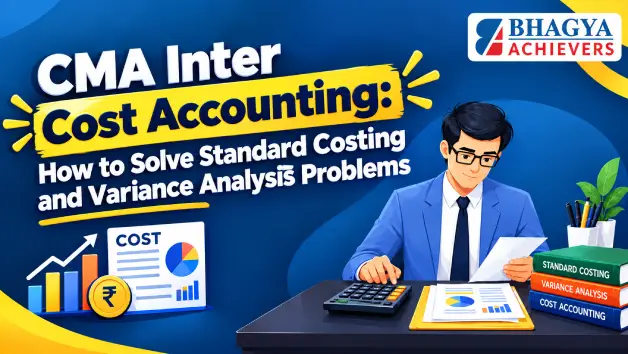
CMA Inter Cost Accounting: How to Solve Standard Costing and Variance Analysis Problems
Table of Contents
Preparing for CMA Inter Cost Accounting and finding Standard Costing and Variance Analysis difficult? From Material Price Variance and Material Usage Variance to Labour Rate and Labour Efficiency Variance, each question requires the right formula and calculation approach.
This guide explains the important concepts, formulas and practical steps that students need to solve CMA Inter Standard Costing Problems Clearly.
What is Standard Costing in CMA Inter?
Standard costing is a technique in which a predetermined cost is fixed and is compared with the actual cost. The difference between standard and actual performance is called a variance.
Standard Cost → Actual Cost → Difference → Variance Analysis → Reason for Difference
Standard costing mainly helps to measure performance, controlling costs and identifying areas where actual results differ from the expected results.
What is Variance Analysis?
Variance Analysis means finding and analysing the difference between standard performance and actual performance.
For CMA Inter Cost Accounting and Management Accounting questions, students should firstly identify what the question is asking about:
- Material Variance
- Labour Variance
- Variable overhead variance
- Fixed overhead variance
- Sales variance
Want CMA Inter Free Study Notes PDF? Click here
How Should Students Start a Standard Costing Problem?
Do not start calculating immediately, students must follow the given below steps:
- Read the question carefully
- Identify the standard quantity/rate
- Analyze the actual quantity/rate
- Identify the actual input
- Find the exact variance asked
- Write the exact formula
- Substitute the figures
- Mention whether the result is Favourable (F) or Adverse (A)
How can Students Solve Material Cost Variance Problems?
Material cost variance shows the difference between the standard material cost for actual output and the actual material cost.
It can be analyzed into:
- Material Price Variance
- Material usage Variance
- Material Mix Variance, where applicable
- Material Yield Variance, Where applicable
For a basic question: Material Cost Variance = Standard Cost − Actual Cost
Students should first calculate the total material cost and then break it into the required components.
Attempt CMA Inter Mock Test Series Now
How can Students Calculate Material Price Variance?
Material Price Variance shows the difference between the standard price and the actual price paid for materials.
Formula:
Material Price Variance = Actual Quantity × (Standard Price − Actual Price)
- If the actual price is lower than the standard price → Favourable (F).
- If the actual price is higher than the standard price → Adverse (A).
How to Solve Material Mix Variance Questions?
Material Mix Variance is calculated when two or more materials are used to make a product. It shows the effect of using materials in a different proportion from the standard mix.
Simple Steps:
- Find the revised standard quantity for each material.
- Compare it with the actual quantity used.
- Multiply the difference by the standard price.
- Calculate the variance for each material.
- Add all the variances to get the Material Mix Variance.
Click here to get CMA Inter Chapterwise Test Series Now
How can Students Calculate Labour Rate Variance?
Labour Rate Variance is a method that shows the difference between the standard wage rate and the actual wage rate that is paid to workers.
Formula:
Labour Rate Variance = Actual Hours × (Standard Rate − Actual Rate)
- Actual rate lower than standard rate → Favourable (F)
- Actual rate higher than standard rate → Adverse (A)
How Students can Calculate Labour Efficiency Variance?
The term “Labour Efficiency Variance” shows the difference between the standard hours and actual hours worked for the actual output.
Formula:
Labour Efficiency Variance = Standard Rate × (Standard Hours − Actual Hours)
- Actual hours are less than standard hours → Favourable (F).
- Actual hours are more than standard hours → Adverse (A).
Get CMA Inter Full Syllabus Test Series Here
How can Students Check Whether a Variance is Favourable or Adverse?
After calculating the whole amount, students must check whether the actual result is better or worse than the standard.
For Cost Variances:
- Lower Actual Cost → generally Favourable
- Higher Actual Cost → generally Adverse
For Example: If a material costs less than the standard price, the difference of the price will be Favourable.
Can Standard Costing Questions be Scored easily in CMA Inter?
Yes, Standard Costing questions can be scored if the formula and calculation steps are clear or understandable.
For a good answer, students can follow the given below order:
Formula → Working → Calculation → Final Answer → F/A
Students must focus on using the correct formula, figures and working steps to avoid calculation mistakes.
How can Bhagya Achievers help in CMA Inter Cost Accounting Preparation?
Bhagya Achievers helps CMA Inter students to practice through Test Series and expert guidance. Students can attempt Cost Accounting questions, check their performance properly and can understand where they are making mistakes again and again.
Bhagya Achievers also provides Free Study Notes that can help students to make their preparation more strong. It also provides regular mock-tests that can improve students calculation speed, answer-writing presentation and overall exam-performance.
Get Bhagya Achievers CMA Inter Free Study Notes Here
FREQUENTLY ASKED QUESTIONS:
Ques: What is Standard Costing in CMA Inter?
Ans: Standard Costing is a technique where standard costs are fixed in advance and compared with the actual costs to find variances.
Ques: What is the formula for Material Price Variance?
Ans: Material Price Variance = Actual Quantity × (Standard Price − Actual Price).
Ques: What are the main Labour Variances?
Ans: The main Labour Variances includes: Labour Cost Variance, Labour Rate Variance, Labour Efficiency Variance and Labour Mix Variance.
Ques: What does Favourable Variance means?
Ans: A Favourable (F) variance generally means that the actual cost is lower than the standard cost or the actual performance is better than the standard.
Ques: Are Standard Costing questions scoring in CMA Inter?
Ans: Yes, With regular practice, students can score well by focusing on correct formulas, calculations, working notes and proper presentation.’
Ques: What does Adverse Variance Means?
Ans: An Adverse (A) Variance means that the actual cost is higher than the standard cost or the actual performance is worse than the standard.
Ques: Why is Actual output important in Variance Analysis?
Ans: Actual output helps students to calculate the standard quantity or standard hours needed for the actual production. This makes it easier for students to compare the expected cost with the actual cost and calculate the correct variance.
ALSO CHECK:
- Why Cost & Management Accounting is Crucial for Business Profitability and Growth
- How to Prepare Effective Notes for CMA for Maximum Retention?
- CMA Coaching vs Self-Study - Which is the Best Path for Exam Success?
- Cost Accounting Essentials: Key Cost Components You Must Know
- Top Resources and Books for CMA Students Preparing for ICMAI Exams
- Is CMA is easier than MBA
- Importance & Role of Mock Tests n CMA Exam Preparation
Recent Posts
-
CMA Inter Financial Accounting: Common Adjustments ..
 31st October, 2026
-
CMA Exam Preparation: How to Improve Working Notes,..
30th October, 2026
-
CMA Final Strategic Cost Management: How to Approac..
30th October, 2026
-
CMA Inter Cost Accounting: How to Solve Standard Co..
30th October, 2026
-
CS Exam Answer Writing: How to Use Legal Sections, ..
30th October, 2026
-

CS Executive Tax Laws: How to Connect Legal Provisi..
23rd October, 2026
-

How to Prepare for ICSI Open Book Examinations: Res..
16th October, 2026
-

CS Professional Drafting Questions: A Practical Gui..
16th October, 2026
-
CS Executive Company Law Case Studies: How to Ident..
16th October, 2026
-
CA Exam Preparation After Completing the Syllabus: ..
6th October, 2026
-
ICAI RTP, MTP and Previous Year Papers: How to Use ..
6th October, 2026
-

CA Inter Taxation: How to Prepare for Questions Inv..
6th October, 2026
-

CA Exam Answer Presentation: How to Structure Your ..
6th October, 2026
-

Test Series vs Self-Study: What Actually Improves Y..
1st October, 2026
-

CA Foundation to Final: A Test Series Roadmap for E..
30th September, 2026


