

 26th November, 2026
 Mentoring Program
 Bhagya Achievers
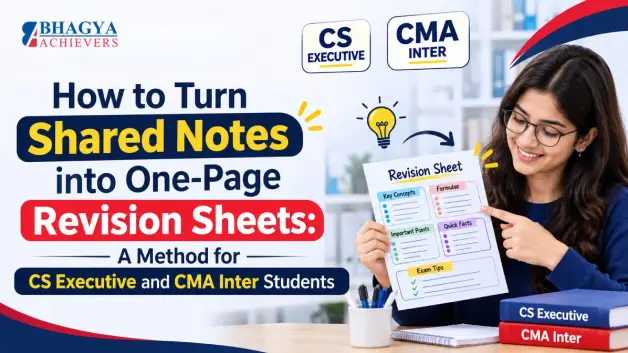
How to Turn Shared Notes into One-Page Revision Sheets: A Method for CS Executive and CMA Inter Students
Table of Contents
Why use one-page sheets?
CS Executive and CMA Inter both carry heavy theory and application. Long notes are useful for learning, but in the final weeks you need a format you can scan in minutes and recall under pressure.
A one-page sheet also forces choices. You cannot copy a whole chapter onto one page, so you must decide which definitions, provisions and formulas matter most. That decision is itself revision, because choosing what to keep requires you to understand the chapter. Students who rely only on long notes often find in the last week that they have no time to read everything again and no clear idea of what to skip.
The 4-box method
- Core concepts: definitions and principles in your own words.
- Formulas or provisions: the exact items you must reproduce.
- Common mistakes: errors you or other students have made.
- Practice question: one question that tests the chapter.
The four boxes are intentionally small. If a box overflows, you are probably including detail that belongs in the full notes. Keep the sheet to what you must reproduce or recognise, and let the notes remain your reference for everything else.
Step-by-step process
- Read the chapter in the CS Executive notes or CMA Inter notes.
- Close the notes and fill the four boxes from memory.
- Open the notes again and correct gaps in a different colour.
- Attempt the practice question in writing.
- Place the sheet in your revision folder, grouped by paper.
What does a filled sheet look like?
Take a CMA Inter costing chapter on marginal costing as an example. Core concepts: marginal cost is the cost of one more unit, contribution is what each unit adds towards fixed cost and profit. Formulas: contribution = sales minus variable cost; P/V ratio = contribution divided by sales; break-even sales = fixed cost divided by P/V ratio. Common mistakes: treating fixed cost as part of unit variable cost, or forgetting to change the break-even point when selling price changes. Practice question: one short problem on break-even and margin of safety.
For a CS Executive chapter, the structure is the same but the content changes. Core concepts hold the key definitions and principles, the provisions box holds the exact sections, timelines or limits you must state, the mistakes box lists the confusions you noticed, and the practice question is a short answer or case-style question on the chapter.
How does this help in CS and CMA papers?
For CS, knowing how marks are cleared matters as much as theory; see Passing Criteria Explained for CS Executive Subjects. For current affairs and recent developments, use the method in our current affairs preparation guide for CS students. For CMA, link formulas to practical use as explained in CMA Exam Revision: Connect Cost Accounting Formulas with Practical Applications, and review answer structure in How to Write Answers for CMA Law and Ethics Papers.
Add testing and feedback
Use the CS test series or CMA test series to check whether your sheets work under timed conditions. Update the "common mistakes" box after every test. Post unresolved points in Study Doubts.
Revisit each sheet at least three times. Look at it a day after you make it, then after a week, and again before a mock test. At each visit, cover the sheet, recall as much as you can, and uncover it to check. Add only what you missed. A sheet that keeps growing is a sign that you are copying the notes instead of recalling them.
More notes by level
Use the same method for every level, but adjust the depth. Foundation sheets can lean on definitions, Executive or Inter sheets on application, and Professional or Final sheets on detailed provisions and reasoning.
FAQs
Q1. How many sheets should I make?
One per chapter is a practical starting point; merge related chapters in the final week.
Q2.Should I make sheets by hand or digitally?
Handwriting suits answer-writing practice; digital sheets are easier to update. Choose what you will actually revise.
Q3. When should I start making sheets?
After the first full reading of a chapter, not at the end of the syllabus.
Q4. Can I use the same method for CA?
Yes. See Blog 1 for the CA-specific approach.
Q5. What if a chapter does not fit on one page?
Split it into two sheets by sub-topic, but keep each sheet to the four boxes. If a chapter still needs many pages, you are probably including detail that you do not need to recall.
Q6. Should I share my sheets with others?
Yes, if you are confident they are accurate. Sharing in the community also lets others point out mistakes, which improves your sheet, but always check the points against your prescribed material first
Recent Posts
-
How to Turn Shared Notes into One-Page Revision She..
 26th November, 2026
-
CS Executive Test Series: Module-wise and Full-Leng..
19th November, 2026
-

Best Test Series Combination for CA Inter: Chapter-..
19th November, 2026
-
Banking Awareness Revision System: Monthly Plan for..
16th November, 2026
-

Sectional Cut-Offs in Bank Prelims: How to Avoid Fa..
16th November, 2026
-
How to Write Answers for CMA Law and Ethics Papers..
13th November, 2026
-
CMA Inter and Final: Should You Attempt One Group o..
13th November, 2026
-
Passing Criteria Explained for CS Executive Subject..
11th November, 2026
-

Current Affairs Preparation Methods for Company Sec..
11th November, 2026
-
Online Examination Guidelines for CS Candidates..
11th November, 2026
-
Guide to Preparing for Multiple CA Exam Papers Toge..
11th November, 2026
-
How to Verify Your CA Study Material Matches the Ap..
11th November, 2026
-
CA Exam Result and Marks Verification: Options Avai..
11th November, 2026
-
CA Final Case Study Questions: A Step-by-Step Appro..
3rd November, 2026
-
Bank Exam Language Proficiency Test: Eligibility, L..
3rd November, 2026


