

 2nd November, 2026
 Bank Exams
 Bhagya Achievers
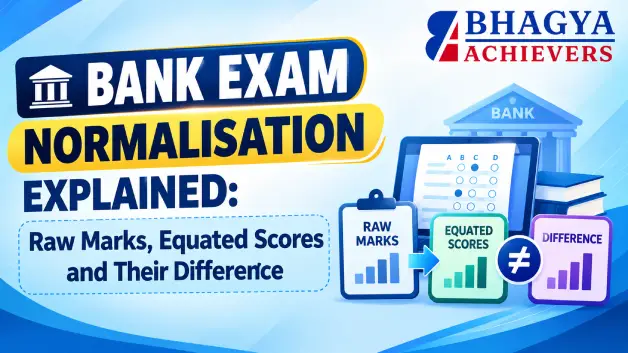
Bank Exam Normalisation Explained: Raw Marks, Equated Scores and Their Difference
Table of Contents
Can scoring higher marks in a bank exam still lead to a lower final score after normalization? This is why understanding bank exam normalization matters, especially when exams are conducted in multiple shifts.
From raw marks to equated scores, this guide will explain to you how scores are calculated, why they may change, and how normalisation can affect bank exam cut-offs and selection.
What is Normalisation in Bank Exams?
Normalisation is a statistical process used to make candidates score comparable when an examination is conducted in multiple shifts with different question papers.
Basically:
- It is used when an exam is conducted in multiple shifts.
- It accounts for differences in question paper difficulty across different sessions.
- The adjusted score may be higher or lower than the raw marks.
What is the difference between raw marks and equated score?
|
Term |
Simple Meaning |
Who Uses It? |
|
Raw Marks |
The marks you calculate using the answer key after adding marks for correct answers and deducting negative marks. |
You and other students |
|
Equated Score |
The score calculated by the exam authority after adjusting for differences in the difficulty level of different shifts. |
The exam authority to prepare results and cut-offs |
Does a higher raw score always mean a higher final score?
- If both students are in the same shift: A student with higher raw marks will generally have a higher equated score.
- If students are in different shifts: Not always. A student with lower raw marks in a tougher shift may get a higher equated score than a student with higher raw marks in an easier shift. This mainly depends on the exam authority’s score adjustment method.
Is Negative Marking applied before or after normalisation?
- Negative Marking is applied first: Your score is calculated after adding marks for correct answers and deducting marks for wrong answers.
- Wrong answers can reduce your score: Avoid guessing blindly without understanding the question and attempt each and every question carefully.
- Want to learn how to avoid losing marks? Read the given below article:
Negative Marking in Bank Exams: How Test Series Practice Helps You Make Smarter Attempt Decisions
Can I calculate my exact equated score before the result?
Your exact score can be confirmed only when the exam authority releases the result. The score depends on the normalisation process and the performance of candidates across different shifts. Online normalisation calculators can give you an estimated score, but the actual score may be different.
Are Cut-offs based on raw marks or equated scores?
Cut-offs are generally based on the final score after normalisation, if the exam authority uses this process. Your raw marks and final score may be different, so your cut-off result may not match with your calculation.
Talk to an expert and get a straight answer
What should Aspirants do about Normalisation?
Normalisation is not under the control of an aspirant, but the exam preparation is. Instead of worrying about whether your shift will be easy or difficult, focus on improving your score and avoiding mistakes. Here are few things an aspirant can do to improve the chances of selection
- Try to score as high as possible: Attempt all questions carefully and avoid unnecessary negative making.
- Focus on every section: Don’t just aim for a good overall score. Try to clear the cut-off for each section, too.
- Don’t worry about your exam shift: Mainly focus on your preparation well, don’t get confused about anything. Keep calm and do your best in the exam.
- Practice with mock tests: Take full-length mock tests within the actual exam time limit to improve your speed and accuracy.
- Check the official notification: Always read the official exam notification carefully to understand how marks are calculated and normalised.
Stop guessing your level. Test it.
What are the biggest myths about normalisation?
|
Myth |
Reality |
|
“Normalisation increases everyone’s marks.” |
Normalisation can increase or decrease your score, depending on the exam rules and shift difficulty. |
|
“Raw marks decide selection.” |
If normalisation is used, the final equated score is generally considered for results and cut-offs. |
|
“An easy shift guarantees selection.” |
Selection depends on your final score, cut-off and overall performance. |
|
“A tough shift guarantees extra marks.” |
A tougher shift does not guarantee extra marks. The score adjustment depends on the normalisation method. |
|
“I can calculate my exact final score.” |
You can estimate your score, but the exact equated score depends on the exam authority’s data and calculation method. |
FREQUENTLY ASKED QUESTIONS:
Ques: What is the difference between raw marks and normalised marks?
Ans: Raw marks are calculated from the exam response, while normalised marks are adjusted using the prescribed statistical method.
Ques: What is an equated score in IBPS Exams?
Ans: It is a score adjusted to make performance across different exam sessions comparable under the applicable scoring method.
Ques: Can a candidate with lower raw marks get a higher normalised score?
Ans: Yes, this is possible depending on the session-wise score distributions and the normalisation method.
Ques: Is Normalisation the same as the percentile scoring?
Ans: No, Percentile scoring expresses relative performance, while normalisation is a process for making scores comparable. Some normalisation methods use percentile relationships.
Ques: Does a Normalisation guarantee an increase in marks?
Ans: No, the adjusted score may increase or decrease.
Ques: Is Normalisation applied to every Bank Exam?
Ans: No, its application depends on the examination structure and official recruitment rules.
Ques: Are Raw Marks used for the final Bank Exam merit list?
Ans: Not always, The authority may use corrected, equated, normalised or converted scores according to the official selection rules.
ALSO CHECK:
- Banking Maths Shortcuts: 50 Tricks for IBPS/SBI
- SBI PO Preparation Tips: Conquering the Toughest Bank Exam
- How to Clear Bank Exams on Your First Attempt: A Step-by-Step Guide
- Comparing SBI Clerk and IBPS Clerk Career Growth
- Why Do Current Affairs Play a Key Role in Banking Exams?
- Smart Techniques to Clear IBPS Clerk Exam Quickly
- Why Students Trust Bhagya Achievers for Bank Exam Preparation (IBPS, SBI & RRB)
Recent Posts
-
IBPS PO vs SBI PO vs RBI Assistant: Difference in E..
 2nd November, 2026
-
Bank Exam Normalisation Explained: Raw Marks, Equat..
2nd November, 2026
-

CMA Exam Revision: How to Connect Cost Accounting F..
2nd November, 2026
-

CMA Inter Financial Accounting: Common Adjustments ..
31st October, 2026
-

CMA Exam Preparation: How to Improve Working Notes,..
30th October, 2026
-

CMA Final Strategic Cost Management: How to Approac..
30th October, 2026
-
CMA Inter Cost Accounting: How to Solve Standard Co..
30th October, 2026
-

CS Exam Answer Writing: How to Use Legal Sections, ..
30th October, 2026
-

CS Executive Tax Laws: How to Connect Legal Provisi..
23rd October, 2026
-

How to Prepare for ICSI Open Book Examinations: Res..
16th October, 2026
-

CS Professional Drafting Questions: A Practical Gui..
16th October, 2026
-

CS Executive Company Law Case Studies: How to Ident..
16th October, 2026
-

CA Exam Preparation After Completing the Syllabus: ..
6th October, 2026
-

ICAI RTP, MTP and Previous Year Papers: How to Use ..
6th October, 2026
-

CA Inter Taxation: How to Prepare for Questions Inv..
6th October, 2026


