

 25th July, 2026
 Bank Exams
 Bhagya Achievers
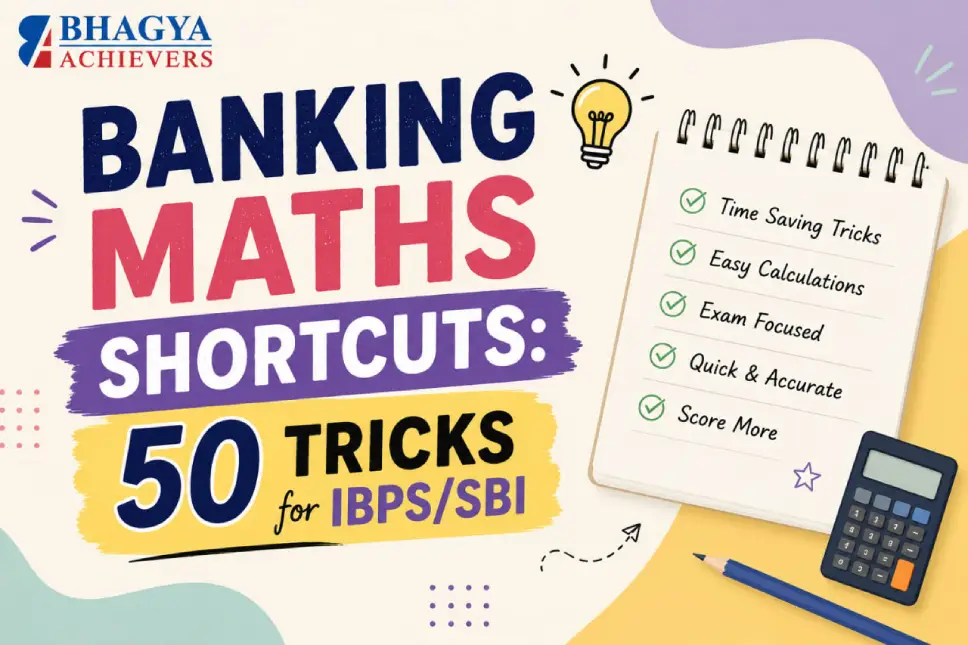
Banking Maths Shortcuts: 50 Tricks for IBPS/SBI
Table of Contents
Want to solve Banking Maths questions in half the time and increase your chances of success in IBPS & SBI exams?
Learn 50 powerful banking maths shortcuts, quick calculation tricks and time – saving techniques that not only help you solve quant questions faster but also help to improve accuracy and maximize your score.
Percentage and Fraction Shortcuts
- Remember these common fractions:
- 1/2 = 50%
- 1/3 = 33.33%
- 1/4 = 25%
- 1/5 = 20%
- 1/6 = 16.67%
- 1/8 = 12.5%
- 1/9 = 11.11%
- To find 12.5% of any number, simply divide it by 8.
- To find 16.67%, divide by 6. To find 33.33%, divide by 3.
- To increase a number by 20%, multiply it by 1.2. To decrease it by 20%, multiply it by 0.8.
- If a number first increases and then decreases (or vice versa), don't cancel the percentages. Use:
Net Change = a + b + (a × b ÷ 100)
Example: +10% and -10% = -1%, not 0%. - In DI questions, compare percentages by checking the difference with the original value instead of solving everything.
- If options are not close, compare the ratios first instead of calculating exact percentages.
- Remember these useful values:
- 37.5% = 3/8
- 62.5% = 5/8
- First find 1% of the number, then multiply it.
Example: 1% of 840 = 8.4, so 17% = 8.4 × 17. - To find 99%, subtract 1% from the number. To find 101%, add 1%.
Simplification and Approximation Shortcuts
Use approximation only when answer options are far apart. If options are close, solve exactly.
- To multiply by 25, multiply by 100 and divide by 4.
Example: 48 × 25 = 4800 ÷ 4 = 1200. - When multiplying numbers close to 100, use the difference from 100 to calculate faster.
- To divide by 5, multiply by 2 and then divide by 10.
- To divide by 25, multiply by 4 and divide by 100.
- To multiply a two-digit number by 11, add both digits and place the answer in the middle.
Example: 43 × 11 = 473. - To multiply by 99, multiply by 100 and subtract the original number.
- Before multiplying fractions, cancel common numbers to make the calculation easier.
- In BODMAS questions, solve brackets first, but check if numbers can be cancelled before doing long calculations.
- Learn squares up to 50 and cubes up to 20 to save time.
Want Free Short tricks PDF notes? Get now
Ratio, Average and Mixture Shortcuts
- If the ratio is a: b, total parts = a + b.
- If the average changes, first find the total increase or decrease, then divide if needed.
- When one new value is added, compare it with the old average to understand how the average changes.
- In mixture questions, use the Allegation Method whenever possible because it is faster.
- In weighted average questions, compare how far each value is from the average to find the ratio.
- In partnership questions, profit is shared according to Capital × Time.
- In age questions, remember that the difference in ages never changes.
- In DI, simplify ratios before solving.
- The average of consecutive numbers is always the middle number.
- For combined averages, first find the total sum of both groups.
Time, Work, Speed, Distance and Interest Shortcuts
- In work questions, take the LCM of the given days as the total work.
- A person who takes less time is more efficient.
Example: 10 days vs. 15 days = Efficiency ratio 3: 2. - In pipes questions:
- Inlet = Positive work (+)
- Outlet = Negative work (-)
- For equal distances, Average Speed =
2 × Speed1 × Speed2 ÷ (Speed1 + Speed2) - Relative Speed:
- Opposite direction = Add speeds
- Same direction = Subtract speeds
- Train Questions:
- Crossing a pole = Train length
- Crossing a platform = Train length + Platform length
- Simple Interest = (Principal × Rate × Time) ÷ 100
- For Compound Interest (2 years), Effective Rate =
2R + (R² ÷ 100) - In instalment questions, calculate each payment one by one.
- Selling Price =
Cost Price × (100 ± Profit/Loss) % ÷ 100
Data Interpretation (DI) Shortcuts
- First read the title, units and labels carefully before solving.
- Quickly identify the highest and lowest values.
- In pie charts:
Percentage = Degree ÷ 3.6
- In bar graphs, first compare the bar heights. Calculate only if needed.
- In missing value questions, first find the values that are already given.
- For comparison questions, compare ratios instead of finding exact percentages.
- In cumulative tables, subtract the previous value to get the current value.
- Round numbers only when answer options are far apart.
- In caselet DI, write important values on paper instead of remembering everything.
- If you've already calculated a value in one question, use it again instead of calculating it repeatedly.
How to practice these shortcuts the Right way?
- Spend 15 minutes daily learning tables, squares, cubes, and fractions
- Then solve 20 simplification questions and timed DI sets.
- Give more focus on both speed and accuracy
- Practice each shortcut on 30-40 questions before using it in a mock test
- After each mock test analyze your mistakes and improve them
Important tip: A trick you have used only once won’t come to mind during the exam. Try to learn one topic at a time instead of trying to learn all 50 tricks together.
Should I use the same Shortcuts in Prelims and Mains?
- In prelims, shortcuts are all about speed
- In Mains, shortcuts help, but you will still need to think through the arithmetic
- SBI PO and IBPS PO Mains often mix DI with logic – don’t depend on approximation
- Use shortcuts to save time, not to skip understand the question
Practice these shortcuts with real exam-level questions
By practicing these shortcuts with real exam level test series you can improve your chances of success in IBPS and SBI exams.
Click and get free sample test series for practice
FAQs
Ques: Are math shortcuts useful for IBPS PO and SBI PO?
Ans: Yes, using these shortcuts allows the students to answer quickly and accurately for the Quantitative Aptitude section.
Ques: Can I crack IBPS math using shortcuts only?
Ans: Yes, but shortcuts works best when they're used with strong concepts and daily practice.
Ques: How can I improve calculation speed for bank exams?
Ans: Practice mental calculations and shortcut tricks daily.
Ques: Which bank exams require Math shortcuts?
Ans: IBPS PO, IBPS Clerk, SBI PO, SBI Clerk, RRB, RBI Assistant, and LIC exams.
Ques: What is the fastest way to solve simplification questions?
Ans: You need to follow BODMAS and multiplication and percentage tricks to solve simplification questions fast.
Also Check:
- Mastering Quantitative Aptitude for Competitive Banking Tests
- Effective Time Management Methods for Banking Exams
- Boost Your Reading Speed and Vocabulary with Smart Learning Tools
- Confusing Puzzling Statements in Reasoning Puzzles & Seating Arrangements for bank exams
- Best Speed Math Techniques for SBI, IBPS & SSC Exams
- How to Use Community Notes to Improve Quant Speed for IBPS Clerk (CRP-CSA-XV)
- How to Clear Bank Exams on Your First Attempt: A Step-by-Step Guide
- 'Bhagya Achievers' Step-by-Step Bank Exam Success Plan for 2026
Recent Posts
-
CA Exam Preparation After Completing the Syllabus: ..
 6th October, 2026
-
CAI RTP, MTP and Previous Year Papers: How to Use T..
6th October, 2026
-
CA Inter Taxation: How to Prepare for Questions Inv..
6th October, 2026
-
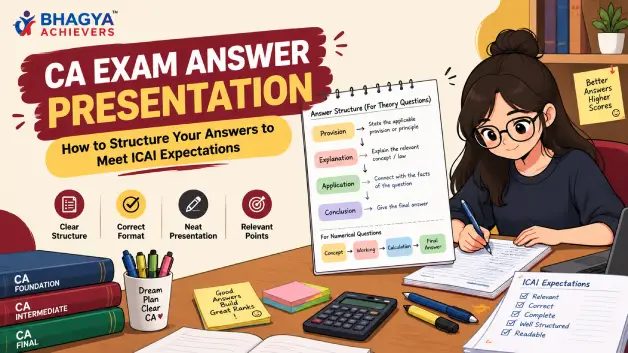
CA Exam Answer Presentation: How to Structure Your ..
6th October, 2026
-

Test Series vs Self-Study: What Actually Improves Y..
1st October, 2026
-
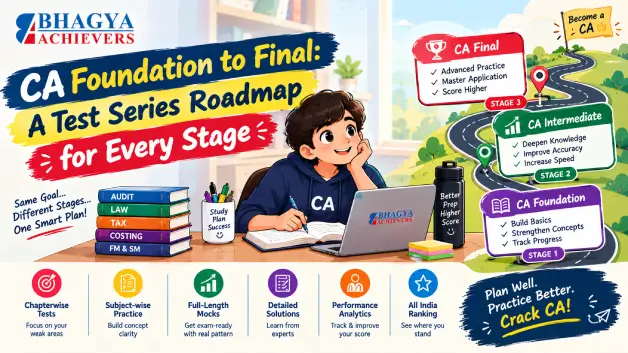
CA Foundation to Final: A Test Series Roadmap for E..
30th September, 2026
-
How to Use Mock Test Results to Boost Your CA Score..
30th September, 2026
-

5 Reasons Toppers Swear by Test Series Before CA Ex..
26th September, 2026
-

Why CA Final Online Test Series Is a Game-Changer f..
25th September, 2026
-

CA Final Now Twice a Year (May & November): How..
22nd September, 2026
-

Why Your Bank Exam Score Isn’t Improving Despite ..
22nd September, 2026
-
Negative Marking in Bank Exams: How Test Series Pra..
20th September, 2026
-

Free vs Paid Bank Exam Test Series: What’s the Re..
20th September, 2026
-
AI-Based Performance Analytics in Bank Exam Test Se..
16th September, 2026
-
Descriptive Paper & Interview Prep for Bank PO ..
16th September, 2026


