

 18th May, 2026
 Bank Exams
 Bhagya Achievers
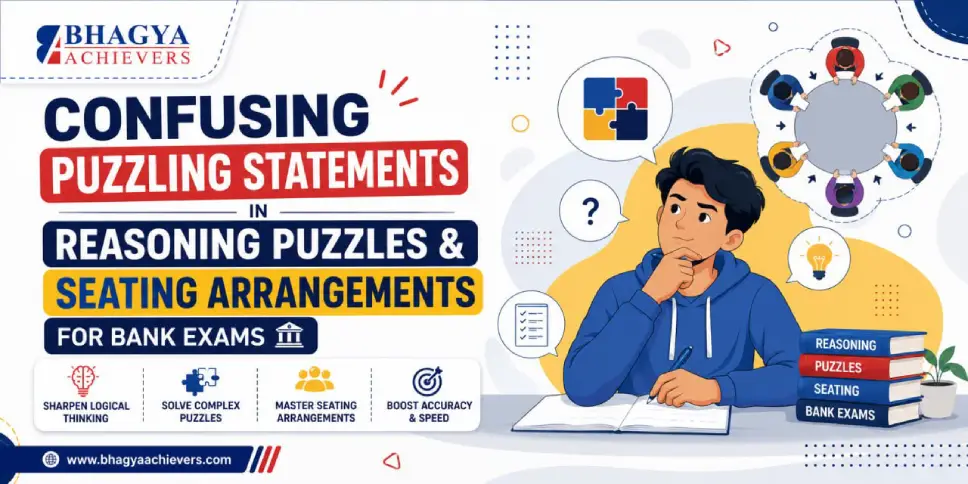
Confusing Puzzling Statements in Reasoning Puzzles & Seating Arrangements for Bank Exams
Table of Contents
Have you ever solved an entire seating arrangement puzzle confidently but still got the answer wrong because of one confusing statement? Many students face this issue while preparing for the bank exam and lose score even knowing the concept.
Want to increase your puzzle – solving accuracy and avoid these mistakes? Then this blog is for you.
Why do Aspirants Get Confused in seating arrangement questions?
Most confusion happens because:
- Left and right change when people face various directions
- Statements are not direct and are written in a tricky way
- Words like “not”, “except” or “neither” create confusion
- Too many things mixed together in one question
- Students guess instead of understanding the statement properly
The main idea is to turn every sentence into a simple picture in your mind.
What are the most confusing statements in Seating Arrangement Questions?
In Bank exams, some statements repeatedly confuse aspirants in bank exams.
- Immediate left vs. Second Left
Statement:
“A sits immediately to the left of B.”
Meaning:
A is exactly beside B.
Statement:
“A sits second to the left of B”
Meaning:
One person sit between A and B
Click and get 25+ marks in reasoning section
- Immediate Neighbour vs Not Immediate Neighbour
Statement:
“A is not an immediate neighbour of B”
Meaning:
A and B cannot sit side by side.
But they can still sit in the same arrangement
- One of the Neighbours
Statement:
“One of the neighbours of A is B.”
Meaning:
B can sit either left or right of A.
Do not fix positions immediately
Why is “Facing Center” and “Facing Outside” So Confusing in a Circular seating arrangement?
In reasoning puzzles, this is one of the biggest confusion areas.
Confusing Puzzle Statements Example:
- “A faces the center”
- “B faces outside”
- “C sits third to the left of D who faces the center”
The entire direction changes depending on facing direction.
Important Rule:
Facing Center
- Left = Clock wise
- Right = Anticlockwise
Facing outside
- Left = Ant-clockwise
- Right = Clock wise
What does “Not More Than” Mean in Reasoning Puzzles?
Many students get confused with conditional statements.
Confusing Puzzle Statement Example
“Not more than two persons sit between A and B”
Meaning:
- 0 Persons
- 1 Person
- 2 Persons
But
- 3 or more persons are not possible
These conditional clues need careful interpretation.
Attempt free reasoning mock tests papers now
Why Do “Between” Statements Confuse Students?
Confusing Puzzle Statement Example
“Two people sit between A and B.”
Correct Arrangement
A_ _ B
Instead of persons, many students mistakenly count positions instead of persons.
Another Example
“Only one person sits between P and Q”
Correct Arrangement:
P_Q
For seating arrangement accuracy, understanding the gap-based clues is very important.
What are the most confusing statements in Floor Based Puzzles?
For beginners, floor puzzles confuse students a lot because they contain indirect clues.
Confusing Puzzle Statements Examples
“A lives above B”
Meaning:
A can live on any higher floor.
“A lives immediately above B”
Meaning
A lives exactly one floor higher to B.
“C does not live on an even-numbered floor”
Meaning:
Possible floors:
- 1st
- 3rd
- 5th
- 7th
After seeing negative statements, students often panic.
How should you handle “Either-Or” and “Neither – Nor” Statements?
These are highly confusing puzzle statements in reasoning.
Example:
“Either A or B sits at one of the extreme ends”
Meaning:
Only one of them sits at the extreme end.
Another Example:
“Neither C nor D faces north.”
Meaning:
Both C and D do not face north.
These statements not only require slow reading but also require proper analysis.
Download free Reasoning Notes Now
What mistakes do students make while solving confusing puzzle statements?
- Ignoring negative words like Not, Never, Neither, and Cannot, because they change the entire meaning of the sentence.
- Solving mentally: Always make diagrams because without diagrams, confusion increases.
- Fixing Positions too early: Students start assuming arrangements before verifying clues
- Mixing multiple cases: Different possibilities should always be solved separately.
These mistakes reduce reasoning accuracy in bank exams.
How can beginners Improve Accuracy in Confusing Seating Arrangement Questions?
Below are the best tips:
- Practice statement interpretation: Understand the meaning before solving
- Create Diagrams: Visual representation helps in reducing confusion.
- Learn or understand common puzzle language: Words like adjacent, opposite, consecutive, immediate, extreme end, neighbour, should become familiar.
- Analyze Previous year Questions
What is the Best Strategy to Master Confusing Puzzle Statements for Bank exams?
- Read clues carefully
- Underline important words
- Learn direction rules
- Make proper diagrams
- Solve direct clues first
- Create separate cases
- Practice daily puzzles
- Analyze previous year questions
- Maintain a mistake notebook
- Attempt timer based mock tests
What is the weightage of Puzzles in Bank Exams?
In banking exams, Puzzles and seating arrangement questions carry the highest weightage in the reasoning section.
Approximate Puzzle Weightage in Major Bank Exams
|
Bank Exam |
Puzzle & Seating Arrangement Weightage |
|
IBPS PO Prelims Exam |
15-20 Questions |
|
IBPS SO Mains Exam |
20-30 Questions |
|
SBI PO Prelims Exam |
15-20 Questions |
|
SBI PO Mains Exam |
20-35 Questions |
|
IBPS Clerk Prelims Exam |
10-15 Questions |
|
IBPS Clerk Mains Exam |
15-25 Questions |
|
RBI Assistant Exam |
10-20 Questions |
Download all Bank notes in just one click
FAQs on Confusing Puzzle Statements in Bank Exams
Ques: How to solve seating arrangement questions in bank exams easily and quickly?
Ans: Regular practice puzzle, learn direction rules properly, solve direct clues first and make diagrams properly to solve seating arrangement questions carefully.
Ques: Should I attempt puzzles first or last in exams?
Ans: Try to solve easy and direct puzzles first. At first skip lengthy and confusing puzzles and solve them later if time permits.
Ques: What books are best for puzzle and seating arrangement practice?
Ans: For reasoning preparation, books by Arun Sharma, R.S. Aggarwal, and Bhagya Achievers free community notes are the best.
Ques: How many puzzle questions are asked in SBI PO and IBPS PO exams?
Ans: In SBI PO and IBPS PO exams around 15-35 questions related to puzzle and seating arrangement are asked.
Ques: Why are seating arrangement questions difficult in bank exams?
Ans: Because seating arrangements include confusing statements, uncertain cases, and direction-based clues that make seating arrangement questions tough.
Ques: Which type of puzzle is most important for bank exams?
Ans: Most important topics are circulating seating arrangement, floor puzzles, linear arrangements, and mixed puzzles.
Ques: How can beginners improve puzzle- solving accuracy?
Ans: To improve puzzle accuracy, beginners should start with basic puzzles, practice diagrams daily, and analyse mistakes after every mistake.
Ques: How can Bhagya Achievers Bank Test Series help in puzzle preparation?
Ans: By providing real exam based advanced puzzles and seating arrangements along with detailed solution Bhagya Achievers test series helps students to improve speed and accuracy in bank exams.
Also Check:
- IBPS PO Previous Year Question Papers with Answers PDF - Free Download
- 6 Powerful tools to crack bank exam faster
- GA Questions Asked in SBI Clerk Mains Exam 2025-2026
- Best Speed Math Techniques for SBI, IBPS & SSC Exams
- Daily 20 minute GA strategy for Bank exams by Bhagya Achievers
- How to prepare bank exam in 6 months? Step by step Strategy
- Reasoning Ability Strategy for IBPS RRB PO Exam
- How community notes help mastering Reasoning for IBPS RRB Officer Scale I
- Smart revision techniques used by bank exam toppers
- How to tackle puzzle and seating arrangements in Bank exams?
Recent Posts
-
CA Inter Taxation: How to Prepare for Questions Inv..
 6th October, 2026
-
CA Exam Answer Presentation: How to Structure Your ..
6th October, 2026
-
Test Series vs Self-Study: What Actually Improves Y..
1st October, 2026
-
CA Foundation to Final: A Test Series Roadmap for E..
30th September, 2026
-
How to Use Mock Test Results to Boost Your CA Score..
30th September, 2026
-
5 Reasons Toppers Swear by Test Series Before CA Ex..
26th September, 2026
-
Why CA Final Online Test Series Is a Game-Changer f..
25th September, 2026
-
CA Final Now Twice a Year (May & November): How..
22nd September, 2026
-
Why Your Bank Exam Score Isn’t Improving Despite ..
22nd September, 2026
-
Negative Marking in Bank Exams: How Test Series Pra..
20th September, 2026
-
Free vs Paid Bank Exam Test Series: What’s the Re..
20th September, 2026
-

AI-Based Performance Analytics in Bank Exam Test Se..
16th September, 2026
-
Descriptive Paper & Interview Prep for Bank PO ..
16th September, 2026
-
From Prelims to Mains: A 90-Day Bank Exam Test Seri..
14th September, 2026
-
Banking Awareness & Current Affairs: How Do Dai..
14th September, 2026


