

 31st October, 2026
 CMA- Cost Management Accounting
 Bhagya Achievers
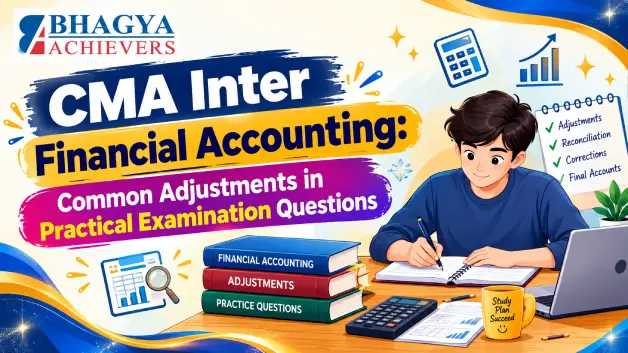
CMA Inter Financial Accounting: Common Adjustments in Practical Examination Questions
Table of Contents
Why do CMA Inter Financial Accounting Questions become tricky when the adjustments begin? A question may look simple, but outstanding expenses, prepaid expenses, depreciation, bad debts and closing stock can change the entire answer.
Knowing the correct treatment of each adjustment is essential for solving CMA Inter Financial Accounting Practical questions accurately and avoiding common exam mistakes.
What are Adjustments in CMA Inter Financial Accounting?
Adjustments are additional pieces of information given along with the Trial Balance while preparing for final accounts. They are used to ensure that income and expenses are recorded in the correct accounting period and the assets are properly mentioned.
Some common adjustments include:
- Closing stock
- Outstanding expenses
- Prepaid expenses
- Accrued income
- Income received in advance
- Depreciation
- Bad debts
- Provisions for doubtful debts
- Interest on capital
- Interest on drawings
- Good withdrawn for personal use
Which Common Adjustments Should CMA Students Prepare for Practical Questions?
Outstanding Expenses
An outstanding expense is an expense that has been incurred but has not yet been paid.
Treatment:
Add it to the related expense in the profit & Loss Account.
Show it as a current liability in the Balance Sheet.
Example: If salary outstanding is ₹5,000, add ₹5,000 to salary expense and show ₹5,000 as a liability.
Prepaid Expenses
A Prepaid expense is an amount already paid for a future accounting period.
Treatment:
- Deduct it from the related expense.
- Show it as a current asset in the Balance Sheet.
Formula: Expense for current year = Expense paid –Prepaid expense
Accrued Income
Accrued Income is income earned during the year but not yet received.
Treatment:
- Add it to the related income.
- Show it as a current asset.
Income Received in Advance
This is income received during the current year but related to a future period.
Treatment:
- Deduct it from the related income.
- Show it as a current liability.
How do I practice adjustments so I don’t forget them in the exam hall?
Students must follow the given below points to avoid their mistakes:
- Practice One adjustment at a time: First, students must solve questions based on outstanding expenses, prepaid expenses, depreciation etc. Once you understand each adjustment, try to solve questions that include multiple adjustments.
- Make a one-page revision chart: Write down where each adjustment goes in the final accounts, such as the Trading Account, Profit and Loss Account and Balanced sheet. Students should revise this chart regularly.
- Solve questions with a timer: Practice full-length questions within the given time limit. This will help students to improve their speed and manage the time during the actual examination.
- Check your mistakes after every test: Students should find out whether they lose marks because of their concept mistakes, calculation errors or poor presentation. Students should regularly practice everyday to improve their mistakes.
- Revise your mistake notebook every week: Write down the adjustments students often forget and the mistakes they are repeating again and again. Revising these notes regularly can be considered more useful than reading the entire chapter again and again.
How do I treat outstanding and prepaid expenses without getting confused?
Always ask one question: Does this expense belong to the current year or the next year?
Outstanding Expense (Add): The expense belongs to this year, but it has not been paid yet.
Example: Rent of ₹4,000 is due but unpaid. Add ₹4,000 to the expense and show it as a liability in the Balance Sheet.
Prepaid Expense (Deduct): The expense has been paid, but it belongs to the next year.
Example: Rent paid includes ₹4,000 for next year. Deduct ₹4,000 from the expense and show it as an asset in the Balance Sheet.
Where Does Each Adjustment Go?
|
Adjustment |
Trading A/c / P&L A/c |
Balance Sheet |
|
Outstanding expense (unpaid expense) |
Add to the expense |
Show as a liability |
|
Prepaid expense (paid in advance) |
Subtract from the expense |
Show as an asset |
|
Accrued income (earned but not received) |
Add to the income |
Show as an asset |
|
Income received in advance |
Subtract from the income |
Show as a liability |
|
Closing stock (given outside the Trial Balance) |
Show on the credit side of Trading A/c |
Show as an asset |
|
Depreciation |
Show as an expense in P&L A/c |
Subtract from the asset's value |
|
Further bad debts |
Show as an expense in P&L A/c |
Subtract from Debtors |
|
Provision for doubtful debts / discount |
Show the increase or decrease in P&L A/c |
Deduct the required provision from Debtors |
|
Interest on capital |
Show as an expense in P&L A/c |
Add to Capital |
|
Interest on drawings |
Show as income in P&L A/c |
Subtract from Capital |
|
Goods taken by the proprietor for personal use |
Subtract from Purchases in Trading A/c |
Subtract from Capital as Drawings |
How Should CMA Students Solve a Financial Accounts Question With Multiple Adjustments?
Students should use the simple sequence:
Step 1: Firstly, Read the trial balance carefully.
Step 2: Read every adjustment separately.
Step 3: Mark the effect of each adjustment.
Step 4: Calculate the adjusted amount where required.
Step 5: Prepare Trading Account and Profit & Loss Account.
Step 6: Prepare the Balance Sheet.
Step 7: Check Whether both sides of the Balance Sheet agree.
One of the useful working approach is:
|
Adjustment |
Profit & Loss / Trading |
Balance Sheet |
|
Outstanding Expense |
Add to expense |
Current Liability |
|
Prepaid Expense |
Deduct from expense |
Current Asset |
|
Accrued Income |
Add to income |
Current Asset |
|
Income Received in Advance |
Deduct from income |
Current Liability |
|
Depreciation |
Expense |
Deduct from Asset |
|
Bad Debts |
Expense |
Deduct from Debtors |
|
Provision for Doubtful Debts |
Adjust provision |
Deduct from Debtors |
|
Closing Stock |
Credit Trading A/c |
Current Asset |
Want to Clear CMA Inter in First Attempt
What are the most common mistakes included in the Adjustment Questions?
CMA Students Commonly make mistakes such as:
- Forgetting Double Effects: Recording adjustments in only one place instead of both the relevant account and the Balance Sheet.
- Wrong Treatment of Outstanding Expenses: Forgetting to add outstanding expenses to the total expense and show them as a liability.
- Incorrect Prepaid Expense Adjustment: Adding Prepaid Expenses instead of deducting them from the current year's expenses.
- Confusing Accrued Income and Advance Income: Treating accrued income as a liability or income received in advance as an asset.
- Wrong Depreciation Calculation: Applying the wrong rate or calculating depreciation on the wrong asset value.
- Incorrect Provision for Doubtful Debts: Calculating the provision on debtors before deducting further bad sheets.
FREQUENTLY ASKED QUESTIONS:
Ques: What is the most common mistake in adjustment questions?
Ans: The most common mistake is forgetting to record both effects of an adjustment.
Ques: Which adjustments are important for CMA Inter Financial Accounting Exams?
Ans: Students should focus on depreciation, closing stock, outstanding and prepaid expenses, bad debts, provisions and managerial commission.
Ques: How do you solve adjustment questions in CMA Inter Financial Accounting?
Ans: Identify the adjustment, understand its accounting treatment, record both effects wherever required and calculate the final amounts carefully.
Ques: How are Prepaid Expenses treated in final accounts?
Ans: Prepaid expenses are deducted from the relevant current year expense and are shown as assets in the Balance Sheet.
Ques: How are bad debts and provision for doubtful debts calculated?
Ans: Deduct bad debts from the debtors first, then calculate the required provision on the adjusted debtors, Consider any existing provision when calculating the expense.
Ques: What should students check before submitting a practical answer?
Ans: Students should check journal entries, calculations, debit and credit totals, both effects of adjustments and the final presentation of accounts.
Ques: Where can students get free study notes for CMA Exam Preparation?
Ans: Students can get free study notes from the Student Community of Bhagya Achievers.
ALSO CHECK:
- Future of Accounting, Taxation, and Compliance Careers in the Digital & AL Era
- Advanced CMA Study Strategy: Using Community Notes, Revision Cycles & Mentor Feedback
- Importance & Role of Mock Tests in CMA Exam Preparation
- Is CMA easier than CA?
- Is CMA still in demand?
- How to clear CMA Inter in First Attempt?
- How many attempts are allowed in CMA?
Recent Posts
-
CMA Inter Financial Accounting: Common Adjustments ..
 31st October, 2026
-
CMA Exam Preparation: How to Improve Working Notes,..
30th October, 2026
-
CMA Final Strategic Cost Management: How to Approac..
30th October, 2026
-
CMA Inter Cost Accounting: How to Solve Standard Co..
30th October, 2026
-
CS Exam Answer Writing: How to Use Legal Sections, ..
30th October, 2026
-
CS Executive Tax Laws: How to Connect Legal Provisi..
23rd October, 2026
-
How to Prepare for ICSI Open Book Examinations: Res..
16th October, 2026
-
CS Professional Drafting Questions: A Practical Gui..
16th October, 2026
-

CS Executive Company Law Case Studies: How to Ident..
16th October, 2026
-
CA Exam Preparation After Completing the Syllabus: ..
6th October, 2026
-
ICAI RTP, MTP and Previous Year Papers: How to Use ..
6th October, 2026
-
CA Inter Taxation: How to Prepare for Questions Inv..
6th October, 2026
-
CA Exam Answer Presentation: How to Structure Your ..
6th October, 2026
-

Test Series vs Self-Study: What Actually Improves Y..
1st October, 2026
-
CA Foundation to Final: A Test Series Roadmap for E..
30th September, 2026


