

 18th February, 2026
 CMA- Cost Management Accounting
 Bhagya Achievers
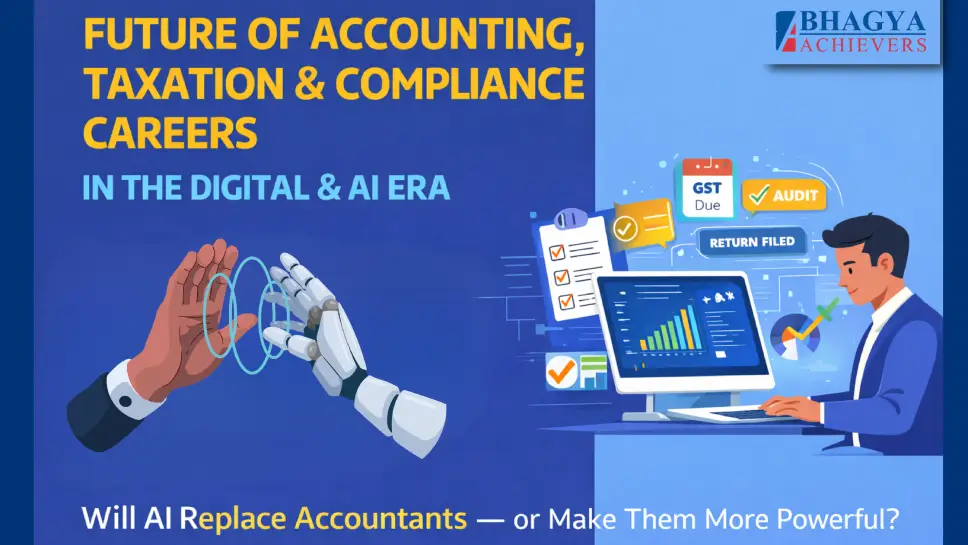
Future of Accounting, Taxation, and Compliance Careers in the Digital & AI Era
Table of Contents
The Accounting profession is standing at a turning point. For decades, accounting, taxation, and compliance were seen as stable and structured careers that built around numbers, regulations, and reporting. Today, the digital revolution and Artificial Intelligence (AI) are transforming how financial work is performed across the world.
Many students and professionals are asking: will AI replace accountants? Is this career still safe? What skills will be needed in the future?
The answer is clear – the profession is not disappearing; it is evolving.
Let’s explore how the future of accounting, taxation, and compliance careers is shaping up in the Digital and AI era.
How Technology is Changing Accounting?
In past years, accounting work was manual:
- Manual Tax calculations
- Filing physical invoices
- Writing entries in books
- Checking transactions one by one
For automated bookkeeping, now most businesses use business accounting software such as Tally Solutions and Zoho Corporation.
Important Fact:
According to multiple industry studies, around 60-70% of routine accounting tasks can be automated using current technology.
This includes:
- Data entry
- Invoice processing
- Bank reconciliation
- Basic tax calculation
This does not mean accountants are not needed. It means their work is shifting from routing tasks to analytical and advisory roles.
Want to build a successful career in Accounting, Taxation & Audit? Start your journey with us today
Growth of AI in Finance – Key data
In the Finance sector, Artificial Intelligence is growing rapidly.
- In 2023, The Global AI in the finance market was valued at over $20 billion.
- It is expected to grow at a rate of more than 20% annually in upcoming years
- Around 80% of finance leaders believe AI lowers operating expenses and increases productivity.
It is evident from these numbers that the use of AI is growing and professionals need to adapt to these changes.
Real Example: Automation in Audit
In the past time, an auditor might check 100-200 sample transactions out of 10,000 transactions from a corporation.
Now, AI-powered audit tools can scan 100% of transactions within minutes.
This improves:
- Accuracy
- Identification of fraud
- Risk identification
Instead of manually checking entries that makes the auditor’s role more strategic, Auditors now analyze patterns and exceptions identified by software
Digital Taxation and Compliance – The New Reality
Governments worldwide are moving toward digital compliance systems. In India:
- E-invoicing is mandatory for business above certain turnover limits
- GST registration and filing are completely online
- Income tax returns are filled digitally
Important Data:
There are more than 1.4 crore GST- registered taxpayers in India.
This shows how large the digital compliance ecosystem has become.
Because compliance is now digital and real-time, companies need professionals who understand:
- Portals for online taxes
- Automated compliance software
- Systems for validating data
Failure to comply can result in heavy penalties. Therefore, compliance experts are in strong demand.
Will Jobs Reduce?
This is the biggest concern about students.
According to global workforce studies:
- Due to automation, about 30% of entry – level accounting task may decline
- However, demand for analytical and advisory roles is increasing
- It is predicted that in the next decade, financial analyst and risk management roles will grow steadily.
This means:
Repetitive jobs may reduce. However, skilled, tech-enabled professionals will grow in demand.
Technology eliminates tasks, not careers.
Ready to crack CA and build a powerful accounting career? Join Now
New Career Opportunities in the Digital Era
Because of AI and digital systems, new roles are emerging.
1.Financial Data Analyst
Professionals who analyze financial data and provide business insights.
Example: Using data tools to identify which product gives the highest profit margin.
2.Forensic Auditor
Use digital tools to find out frauds. The demand for forensic experts is rising globally, with increasing cybercrime and financial fraud.
3.Compliance Risk Manager
Make sure that companies follow proper legal and regulatory framework. Compliance complexity has increased due to more digital reporting requirements.
4.ESG Reporting Specialist
Companies are now required to report Environmental, Social, and Governance Data. Due to investor’s increased interest in sustainable companies, the worldwide ESG market is expanding quickly.
5.Virtual CFO
To manage financial planning and strategy, many start-ups hire part-time or remote CFOs. Digital tools make remote financial leadership possible.
Skills required for the future
Traditional accounting knowledge is still important. But additional skills are now necessary.
Technical Skills:
- Advanced Excel
- Financial modeling
- ERP System
- Data analytical tools
- Cloud accounting software
- Basic AI understanding
- Cyber security awareness
Soft Skills
- Problem – solving
- Communication
- Strategic thinking
- Ethical judgement
According to employer surveys, over 70% of finance recruiters prefer candidates with data analytics skills.
This shows that technical knowledge plus analytical ability is the winning combination.
Cyber security – A Growing Concern
Cyber risks increase as accounting becomes digital. Financial data is highly sensitive. Data breaches can result in:
- Financial losses
- Legal penalties
- Reputation damage
In the coming years, Cybercrime is expected to cost businesses trillions of dollars globally.
Therefore, finance professionals must understand:
- Risk Management
- Data protection
- Secure financial systems
Cyber security knowledge adds strong value to an accountant’s profile.
Step into a successful CA career in the Digital & AI Era — Join Today
Will AI Replace Accountants?
When calculators were first introduced, many people thought accountants would lose their jobs but instead of this calculators simply made calculations faster and more accurate. AI is creating the same fear today – but the reality is similar.
AI can automate repetitive tasks, but cannot replace human judgement, ethics, and strategic thinking.
Studies suggest that while 30% of entry-level repetitive tasks may decline, demand for analytical and advisory roles is increasing steadily.
The future accountant will focus on:
- Financial strategy
- Business advisory
- Risk management
- Analyze performance
AI will be a tool, not a replacement.
What to expect in the next 5-10 years?
In future, we are likely to see:
- Fully automated book keeping system
- Real time Digital tax reporting
- Audit using AI assistance
- Compliance with Blockchain integration
- Increase demand for advisory services
Finance teams may get smaller but more skilled. Companies will seek individuals who can not only evaluate data but also support business choices.
The role of accounting will shift from “recording history” to “predicting the future.”
How can you prepare for the future of Accounting?
To succeed in the AI and digital era, professionals don’t need to fear change – they need to prepare for it. The Accountants who grow with technology will stay in demand.
Here’s what students and professionals should focus on:
- Regularly upgrade skills
- Learn about digital technologies, AI basics and data analytics
- Stay up to date with tax, law, and compliance changes.
- Develop effective communication and practical understanding
- Be open to new ideas and methods of working.
At the same time Educational institutions must also update their curriculum by adding AI, analytics, and digital compliance to their curriculum.
Students who start preparing today will have a strong advantage tomorrow.
FAQs
Ques: Is there still a strong future in accounting and taxation careers?
Ans: Yes, the need for qualified experts in accounting, tax, and compliance is growing as businesses grow and regulations increase, especially those who can use digital tools and AI.
Ques: Which skills matter the most for future professionals?
Ans: Skills which matter the most for future professionals are digital literacy, data analytics, interpretation skills, understanding of laws, and strong communication skills.
Ques: Do future accountants need to learn technology tools?
Ans: Yes, knowledge of excel, automation tools, AI-based software, and data analytics platforms will give professionals a strong advantage.
Ques: Will AI take over tax accounting jobs?
Ans: AI will automate routine tax work, but tax planning, advisory, and interpretation still need humans. Jobs will change, not disappear.
Ques: Is accounting a good career with AI?
Ans: Yes, AI is making the profession more analytical and advisory – oriented. Skilled professionals will remain in high demand.
Ques: How does artificial intelligence affect the tax and accounting profession?
Ans: It increases accuracy and reduces manual labor, allowing professionals to focus more on strategy, compliance and decision – making.
Ques: What accounting jobs will survive AI? Will AI replace accountants by 2030?
Ans: Roles in compliance, taxation, auditing, and consulting will continue to be important. By 2030, AI will help those who adapt, not replace accountants.
Also Check:
- 10 Strong Reasons to Choose a Career as a Chartered Accountant
- CA vs MBA – Which Career Option Offers Better ROI and Long-Term Growth?
- Top Career Opportunities after Becoming a Chartered Accountant in 2026 and Beyond
- Bhagya Achievers’ Proven Approach to CA Exam Success in 2026
- How Bhagya Achievers Helps Students Crack CA Inter & Final in 2026?
- How a CA Mentoring Program Can Transform Your Career Journey?
- Smart Study vs. Hard Study: What Works Best in CA Exams?
Recent Posts
-
How to Prepare for ICSI Open Book Examinations: Res..
 16th October, 2026
-
CS Professional Drafting Questions: A Practical Gui..
16th October, 2026
-

CS Executive Company Law Case Studies: How to Ident..
16th October, 2026
-

CA Exam Preparation After Completing the Syllabus: ..
6th October, 2026
-
ICAI RTP, MTP and Previous Year Papers: How to Use ..
6th October, 2026
-
CA Inter Taxation: How to Prepare for Questions Inv..
6th October, 2026
-
CA Exam Answer Presentation: How to Structure Your ..
6th October, 2026
-

Test Series vs Self-Study: What Actually Improves Y..
1st October, 2026
-
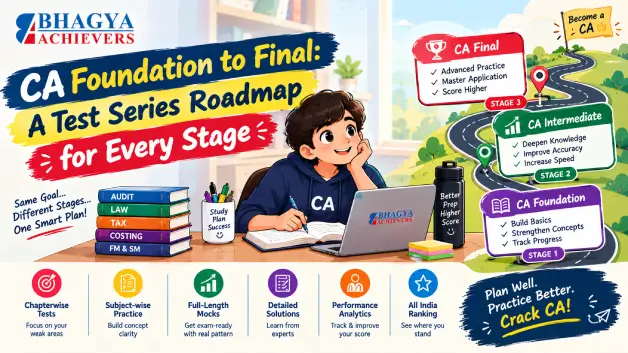
CA Foundation to Final: A Test Series Roadmap for E..
30th September, 2026
-
How to Use Mock Test Results to Boost Your CA Score..
30th September, 2026
-

5 Reasons Toppers Swear by Test Series Before CA Ex..
26th September, 2026
-

Why CA Final Online Test Series Is a Game-Changer f..
25th September, 2026
-
CA Final Now Twice a Year (May & November): How..
22nd September, 2026
-

Why Your Bank Exam Score Isn’t Improving Despite ..
22nd September, 2026
-
Negative Marking in Bank Exams: How Test Series Pra..
20th September, 2026


