


 10th March, 2026
 Bank Exams
 Bhagya Achievers
How to Start Bank Exam Preparation after Graduation – Complete Beginner Guide
Table of Contents
So, you’ve graduated and have no idea how to actually start bank exam preparation. Like from zero. No coaching background. No clue which exam to choose. No idea what to study first.
This guide is for that exact phase.
Bank Exams Overview for Beginners
|
Bank Exams Overview for Beginners |
|||
|
Exam Name |
Conducted by |
Role |
Exam Level |
|
IBPS Clerk |
IBPS |
Clerk |
Easy - Moderate |
|
IBPS PO |
Probationary Officer |
Moderate |
|
|
RRB PO |
Officer Scale – 1 |
||
|
RRB Clerk |
Officer Assistant |
Easy |
|
|
SBI PO |
SBI |
Probationary Officer |
Difficult |
|
SBI Clerk |
Clerk |
Moderate |
|
|
RBI Assistant |
RBI |
Assistant |
Moderate - Difficulty |
|
RBI Grade B |
Officer (Grade B) |
Difficult |
|
Bank Exam Preparation Strategy After Graduation
Let’s break down the beginner’s journey step-by-step for a smooth start.
Understand What “Bank Exams” Actually Mean
In India, “bank exams” are not just one exam but a collection of several exams:
- IBPS Exams: Includes IBPS PO, IBPS Clerk, and IBPS SO.
- SBI Exams: SBI PO, SBI Clerk, and SBI SO
- RBI Exams: RBI Assistant and RBI Grade B
- RRB and Other Bank Exams: Cooperative banks, regional rural banks (RRB), NABARD, etc.
For beginners, IBPS Clerk or SBI Clerk is considered slightly easy entry points. If you want faster growth and better salary, IBPS PO or SBI PO are strong options.
Step 1: Choose One Target Exam
- Avoid the trap of preparing for multiple exams simultaneously. Focus on one target exam for the next 3 to 6 months.
- If you want quicker selection, start with Clerk level exams.
- If you ready to commit 6 to 10 months seriously, go for PO level exams which have tougher reasoning and mains descriptive sections but offer better growth.
My honest suggestion if you’re confused: Choose IBPS PO as your main target and keep Clerk as backup.
Step 2: Understand the Exam Pattern
Knowing the pattern reduces confusion and helps in preparation:
Most Bank Exams have 3 stages:
- Prelims: English Language, Reasoning Ability, Quantitative Aptitude — speed-based.
- Mains: More in-depth sections including advanced reasoning & puzzles, data interpretation, English, general awareness (banking + current affairs), and sometimes computer knowledge.
- Interview: Usually only for PO exams.
Step 3: Use the Syllabus Smartly
- Print and highlight your exam syllabus but don’t blindly follow it because the syllabus is often too broad and does not clearly show what types of questions are repeatedly asked.
- Your real guidance should come from previous year papers and mock tests:
- In your first week, download previous years question papers (Prelims + Mains) of your target exam.
- Scan them to identify frequently asked topics and then create your real preparation roadmap based on these repeated question types.
Step 4: Keep Your Resources Limited
Avoid resource overload by selecting a few good sources:
Section – wise Bank exam Preparation Strategy
Quantitative Aptitude Preparation Strategy
- Choose one book like Arun Sharma (for selected chapters) or R.S. Aggarwal (for basics).
- Focus on key topics: percentages, ratio & average, profit & loss, interest calculations, time & work/speed/distance, mixtures & allegations, mensuration basics, number series, and daily data interpretation practice.
Reasoning Preparation Strategy
- Use one modern reasoning book to focus on reasoning & puzzles.
- Key topics include seating arrangements, puzzles (floor/box/scheduling), syllogisms, inequalities, blood relations, coding-decoding.
English Preparation Strategy
- Pick one reliable source for grammar and vocabulary.
- Daily reading habit is crucial—20 minutes of reading improves your English section.
- Focus Areas: reading comprehension, cloze tests, fillers, error detection, para jumbles.
Bank General Awareness / Current Affairs Preparation Strategy
- Use monthly PDFs or daily YouTube capsules covering banking awareness and recent events consistently.
Mock Test Practice and Performance Analysis
- Start early mock test practice to improve speed, confidence and exam temperament. Analyze mistakes in depth for more improvement.
Attempt Free Now Test Now to Check your Current Knowledge
Step 5: Make a Structured Study Plan
Create a daily timetable based on your availability:
- If you are preparing for full-time: dedicate 5-6 focused study hours is required.
- If you are working and studying together: utilize your early mornings and evenings as much as you can.
Consistency matters more than long hours on random days.
→ A personalized study plan designed by experts can save your time and increase possibility of success ←
Access your mentorship Program: Click here
Bank Exam Preparation Study Plan for Beginners
|
Follow a 90-Day Starter Plan |
|
|
Days 1–15 |
Build basics in quant and reasoning; start English reading habits; begin daily current affairs. |
|
Days 16–45 |
Cover full arithmetic syllabus; practice puzzles daily; take sectional tests; maintain GA notes with weekly revisions. |
|
Days 46–75 |
Do mixed timed practice sets; attempt full-length prelim mock tests twice weekly; start mains-level DI and reasoning sets; solidify last three months’ GA coverage. |
|
Days 76–90 |
Increase mocks frequency to thrice per week; focus on analysis and improving speed/accuracy; revise GA intensively. By day 90, you will be a serious contender ready for the actual exam challenge. |
Step 6: You Should Avoid these Common Mistakes During Bank Exam Preparation
- Waiting endlessly for motivation — start anyway!
- Studying without timing yourself — use timers since bank exams test speed.
- Ignoring GA until last minute — begin current affairs early.
- Switching teachers/resources frequently — stick to chosen materials.
- Only solving easy questions — challenge yourself progressively.
- Skipping revision — revise regularly to retain concepts for a long time.
What if You Feel Late After Graduation?
You’re not late.
Bank exam preparation is not like a 4 year degree where you missed the first semester. People start at 21, 22, 23, even 25.
What matters is:
- How many quality hours you give
- How many mocks you analyze
- Whether you stay consistent for long enough
That’s it.
To Conclude:
Every successful candidate once started from a beginner. The difference is they don’t quit. You should focus on daily improvement, take your mock test seriously, revise from short notes and analyze your mistakes in depth. With discipline and the right strategy, clearing a bank exam is completely achievable.
Frequently Asked Questions
Q: Which bank exam is easy for beginners?
Ans: The IBPS Clerk and SBI Clerk exams are easy for beginners due to its simple exam pattern and less difficulty level.
Q: How many hours do you have to study for a bank exam?
Ans: If you want to clear the bank exam in the first attempt you should study daily 4-5 hours over 2-3 months for effective preparation.
Q: Which bank exam has the highest salary?
Ans: RBI Grade B officers receive the highest salary among other bank exams.
Q: Can I self study for bank exams?
Ans: Yes, self-study works well if you follow a structured plan and use the best study resources and material.
Q: How to start bank exam preparation for beginners?
Ans: Start by selecting one exam, understand its exam pattern and syllabus, choose the best study material, and strictly follow the study plan.
Q: How to start a bank exam from zero?
Ans: When you are at zero begin with basics in Quant, Reasoning, English, and GA; then practice mock tests and analyze them regularly.
Q: How to start a bank exam after 12th?
Ans: After 12th, focus on clerical level exams like IBPS Clerk, prepare basics well, and gradually move towards advanced topics.
Also Check:
- Top Benefits of Bank Exam Mentoring for Aspirants in 2026
- ‘Bhagya Achievers’ Step-by-Step Bank Exam Success Plan for 2026
- How to Clear Bank Exams on Your First Attempt: A Step-by-Step Guide
- Top Banking Jobs in India Offering the Highest Salaries
- Government vs Private Bank Jobs – Which Banking Career Should You Choose?
- Is It Possible to Crack Bank Exams in 3 Months?
- Essential Tips for Success in Your Upcoming Bank Exam
- Why Students Trust Bhagya Achievers for Bank Exam Preparation (IBPS, SBI & RRB)
- Toughest Bank Exam in India: Which One is the Hardest to Crack
Recent Posts
-
How to Prepare for ICSI Open Book Examinations: Res..
 16th October, 2026
-
CS Professional Drafting Questions: A Practical Gui..
16th October, 2026
-
CS Executive Company Law Case Studies: How to Ident..
16th October, 2026
-
CA Exam Preparation After Completing the Syllabus: ..
6th October, 2026
-
ICAI RTP, MTP and Previous Year Papers: How to Use ..
6th October, 2026
-
CA Inter Taxation: How to Prepare for Questions Inv..
6th October, 2026
-
CA Exam Answer Presentation: How to Structure Your ..
6th October, 2026
-
Test Series vs Self-Study: What Actually Improves Y..
1st October, 2026
-
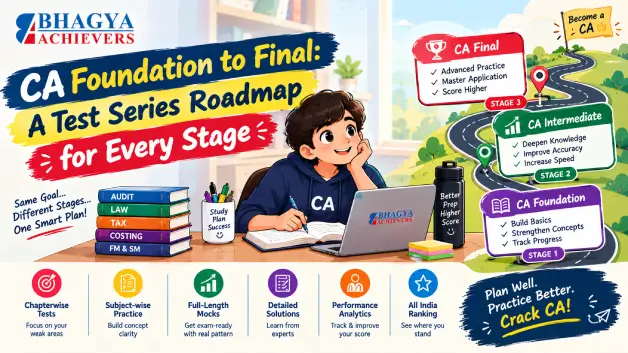
CA Foundation to Final: A Test Series Roadmap for E..
30th September, 2026
-
How to Use Mock Test Results to Boost Your CA Score..
30th September, 2026
-
5 Reasons Toppers Swear by Test Series Before CA Ex..
26th September, 2026
-

Why CA Final Online Test Series Is a Game-Changer f..
25th September, 2026
-
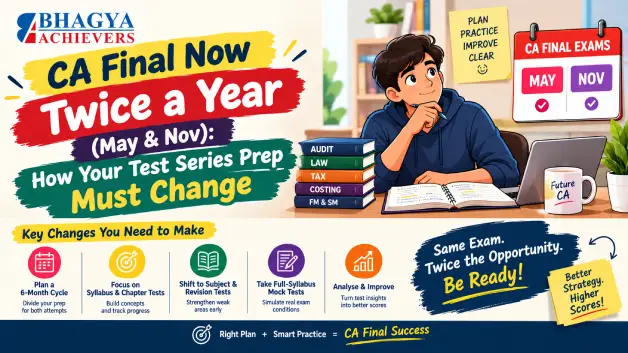
CA Final Now Twice a Year (May & November): How..
22nd September, 2026
-
Why Your Bank Exam Score Isn’t Improving Despite ..
22nd September, 2026
-
Negative Marking in Bank Exams: How Test Series Pra..
20th September, 2026


