

 23rd January, 2026
 CMA- Cost Management Accounting
 Bhagya Achievers
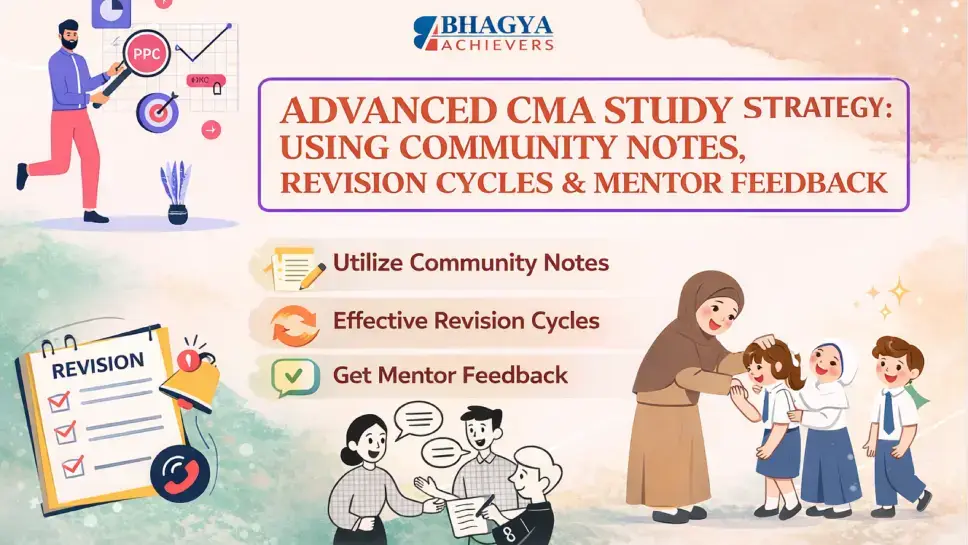
Advanced CMA Study Strategy: Using Community Notes, Revision Cycles & Mentor Feedback
Table of Contents
The CMA exam becomes achievable when students stop feeling lost and start preparing with direction and support
Every attempt, thousands of CMA students complete the syllabus yet only small percentages convert that effort into results. The difference is not intelligence or hours spent. The difference lies in how strategically students use three powerful tools:
- Community Notes
- Structured Revision Cycles
- Continuous mentor feedback
When these three work together, preparation becomes focused, confident, and exam-oriented. When even one is missing, students often feel lost, overworked, and under-confident – especially closer to exams.
This blog explains how to use these three pillars in an advanced, practical way to improve your CMA scores significantly.
Community Notes: Learning Beyond Individual Effort
What Are Community Notes in CMA Preparation?
Community Notes are exam-focused study resources contributed and refined by:
- CMA Inter and CMA Final students sharing real exam experiences
- CMA Inter and Final Toppers highlighting high-scoring areas
- CMA Subject experts adding clarity and structure
Because they come from multiple contributors, community notes are practical, exam evolved, and student – tested – not just only theory.
Why Community Notes Matter More at CMA Level?
CMA syllabus is:
- Vast
- Concept-heavy
- Application – oriented
- Time based
CMA Inter and Final Community notes bring together student experience, topper strategy, and expert guidance – helping you what truly matters in the exam.
They help you:
- Identify repeated exam concepts
- Avoid over-studying low – impact areas
- Focus on exam – relevant concept, not unnecessary theory
- Identify common mistakes students make in exams
How to Use Community Notes Effectively for CMA Exams?
- Always start with ICMAI CMA study material to build strong conceptual clarity
- Use community notes alongside ICMAI material to understand difficult topics in a simpler, student- friendly way
- Refer to community notes after completing each chapter from ICMAI books
- Use them to identify important areas, repeated concepts, and common student mistakes
- Convert key points from both ICMAI material and community notes into short revision notes
- Use community notes mainly during revision cycles to quickly recall concepts
- Avoid using multiple sources
- Discuss confusing points with mentors to ensure concept understanding
Used properly with ICMAI study material, community notes make CMA Preparation clearer, lighter, and more confident.
Click and get Free:
Revision Cycles: Turning Knowledge into recall power
Why One-time Study fails in CMA?
Almost every CMA Student has said this at least once:
“I studied everything, but I couldn’t recall it properly in the exam.”
This happens because CMA exams don’t test whether you have read the syllabus. They test how fast and clearly you can recall and apply concepts under pressure.
Reading once gives understanding
Only revision gives control
This is why one-time study always fails in CMA.
What are Revision Cycles?
Revision cycles mean revising the same syllabus multiple times, but with a clear purpose each time.
You don’t revise to “read again”
You revise to move knowledge from books → mind → exam paper.
Each revision round:
- Becomes shorter
- Becomes sharper
- Increases confidence
This is how toppers remember even in stress.
The 3- level Revision Cycle
Revision Cycle 1: Concept Stabilization
When?
Immediately after finishing a subject or major chapter
Goal:
To understand concepts properly and removes confusion.
What to focus on:
- Why this topic is important for CMA Inter and Final
- How concepts actually work
- Basic logic, not memorisation
What to use:
- Detailed notes
- Faculty/Concept Notes
- Handwritten notes
At this stage, don’t worry about speed
Clarity comes first.
Revision Cycle 2: Compression & Connection
When?
After completing multiple subjects or a full group
Goal:
To reduce syllabus size and connecting topics across chapters
What to focus on:
- Simplify concepts by using short notes
- Link similar concepts across various chapters
- High weightage and most frequent asked questions
What to use:
- Short Notes
- Charts and summaries
- Community – highlighted important areas
- Practice Question and Question Bank
Here, your 100 pages become 30 pages
Revision Cycle 3: Recall & Retention
When?
Close to the exam
Goal:
To recall fast, stay calm, and write confidently.
What to focus on:
- Keywords, formula, formats
- Weak areas and speed
What to use:
- Short Notes and Revision Notes
- MTPs/ Mock test series
- Amendment notes
Fix recall gaps with structured CMA revision cycles – click here
Mentor feedback: The Strategic Advantage in Advanced CMA Preparation
Why is mentor feedback necessary in an Advanced CMA study strategy?
CMA preparation at an advanced level is not about completing the syllabus. It is about completing it strategically.
As Preparation progresses, students face strategic doubts:
- Why are my scores not improving despite multiple revisions?
- Am I revising too much theory and too little application?
- Are these topics worth revising again?
- What should I change in my next revision cycle?
These are strategy-level questions, not academic ones.
Books explain concepts
Mentor feedback shapes strategy.
How Mentor Feedback Improves CMA Preparation?
Effective mentor feedback works at three levels:
Mentors make sure that students focus on high-weightage, repeated areas, and avoid over spending time in low – impact topics.
Mentor track performance and identify weak areas, repeated mistakes and help to correct them before they become habit
Mentor helps in revision by providing revision plan including how many times to revise which keeps revision cycles efficient and exam-oriented.
Mentor Strategies that help students clear the CMA Exam
Advanced CMA mentors guide preparation through clear planning, daily follow-ups, and continuous feedback.
Mentors:
- Create a structured study plan with clear daily and weekly targets
- Do daily follow-ups to track progress and resolve doubts early.
- Provide regular feedback on study quality, not just completion
- Correct mistakes immediately so they are not repeated
- Adjust revision and study focus based on performance
They help students study smarter.
How Mentor Feedback Improves Results?
With regular mentor feedback:
- Mistakes don’t repeat
- Weak subjects don’t remain weak
- Revision becomes easier
- Boost confidence gradually
Mentors act as external eyes – they see problems students are too close to notice themselves.
Study smarter with daily follow-ups and exam-focused mentor feedback – Join Now
Combining All Three: The Advanced CMA Framework
The real benefit is not in using these tools separately, but in integrating them into one system.
How does the combination work?
- Community Notes guide what to focus on
- Revision cycles decide when and how often to revise
- Mentor feedback corrects how you are performing
This creates a closed feedback loop:
Study → Revise → Get Feedback → Improve → Repeat
Over time, preparation becomes:
- More confident
- More structured
- Less Stressful
- More result – oriented
Join our CMA Pass Guarantee Batch with daily mentor follow-ups and result-driven guidance
Final Thought
CMA Inter and Final preparation work best when community notes, structured Revision cycles, and continuous Mentor feedback come together as one system.
At Bhagya Achievers, you get all three under one roof – so you never feel lost, overworked, or unsure of your preparation. Every step is guided, every revision is planned, and every effort moves you closer to results.
Because CMA becomes achievable when preparation has direction – and that direction starts at Bhagya Achievers.
FAQs
Ques: Are Community Notes enough to clear the ICMAI CMA exam?
Ans: No, CMA Community notes are not a replacement tool. They work best when used along with ICMAI study material to improve focus, clarity, and revision efficiency.
Ques: Who prepare ICMAI CMA Community notes?
Ans: ICMAI CMA community notes are prepared by CMA Students, CMA Toppers, and subject experts. Also they are based on real exam-experiences, repeated questions, and common mistakes.
Ques: When should I start using Bhagya Achievers free community notes PDFs?
Ans: Use Community notes along with ICMAI study material for better concept clarity and deep understanding.
Ques: Can I manage CMA preparation without expert feedback?
Ans: Yes, but will not guarantee success. Without mentor feedback, students often revise blindly, repeat mistakes, and fail to improve their score effectively.
Ques: How does mentor feedback help CMA students to improve their marks?
Ans: with the help of mentor feedback, students avoid repeated mistakes, strengthen weak areas, and keeps preparation aligned with exam expectations and scoring patterns.
Ques: What is the biggest mistake CMA student make during revision?
Ans: Revising randomly without a plan. This leads to poor preparation where strong topics get repeated and weak areas are avoided.
Also Check:
- CMA Foundation, Intermediate & Final: Best Community Notes to Use
- How to Prepare Effective Notes for CMA for Maximum Retention?
- CMA Coaching vs. Self-Study – Which is the Best Path for Exam Success?
- How to Master Direct Tax & International Taxation for CMA Final?
- Career Opportunities after CMA India – Sectors, Roles & Salaries
- Importance & Role of Mock Tests in CMA Exam Preparation
- Top Resources and Books for CMA Students Preparing for ICMAI Exams
- Is CMA still in demand?
- Can I Crack CMA by Self-Study?
- How to clear the CMA Final exam in the first attempt?
- How to clear CMA Foundation in the first attempt?
- How to clear CMA Inter in First Attempt?
Recent Posts
-

CS Executive Tax Laws: How to Connect Legal Provisi..
 23rd October, 2026
-

How to Prepare for ICSI Open Book Examinations: Res..
16th October, 2026
-

CS Professional Drafting Questions: A Practical Gui..
16th October, 2026
-

CS Executive Company Law Case Studies: How to Ident..
16th October, 2026
-
CA Exam Preparation After Completing the Syllabus: ..
6th October, 2026
-
ICAI RTP, MTP and Previous Year Papers: How to Use ..
6th October, 2026
-
CA Inter Taxation: How to Prepare for Questions Inv..
6th October, 2026
-

CA Exam Answer Presentation: How to Structure Your ..
6th October, 2026
-

Test Series vs Self-Study: What Actually Improves Y..
1st October, 2026
-
CA Foundation to Final: A Test Series Roadmap for E..
30th September, 2026
-

How to Use Mock Test Results to Boost Your CA Score..
30th September, 2026
-

5 Reasons Toppers Swear by Test Series Before CA Ex..
26th September, 2026
-

Why CA Final Online Test Series Is a Game-Changer f..
25th September, 2026
-

CA Final Now Twice a Year (May & November): How..
22nd September, 2026
-

Why Your Bank Exam Score Isn’t Improving Despite ..
22nd September, 2026


