

 23rd October, 2026
 CS- Company Secretary
 Bhagya Achievers
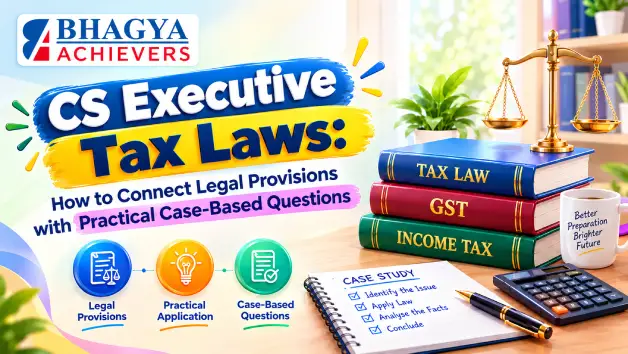
CS Executive Tax Laws: How to Connect Legal Provisions with Practical Case-Based Questions
Table of Contents
A tax provision may look simple in the book, but what happens when the same provision appears in a practical case? This is where CS Executive Tax Laws become more application-based.
Students should read the facts, identify the tax issue, select the relevant provision and must explain how it will apply. Understanding this connection between laws and facts is the key to handling case-based questions with high accuracy.
Why are Case-Based Questions Important in CS Executive Tax Laws?
Case-based questions are important because they test how well students can use tax provisions in practical situations. The questions may give facts about income, deductions, GST transactions, eligibility or tax facility and must ask for the correct tax treatment.
A good answer should include:
- Relevant Provision: Mention the tax rule that can be applied.
- Important Facts: Mention facts which are related to the question.
- Application: Explain how the provision applies to that fact.
- Reasoning: Give a short explanation for the answer
- Conclusion: Clearly write the final answer.
How can Students Identify the Correct Tax Provision in a Case Study?
Students should firstly identify the tax issue hidden in the question. After that, they should look for the important facts such as:
|
Question Gives These Facts |
Area to Check |
|
Salary, allowance or perquisite |
Income from Salary |
|
Rent or property income |
House Property |
|
Business expenses |
Business or Profession |
|
Sale of an asset |
Capital Gains |
|
Income from investments |
Other Sources |
|
Transfer of income/assets |
Clubbing Provisions |
|
Loss from a particular source |
Set-off and Carry Forward |
|
Goods or services supplied |
GST |
|
Tax paid on purchases |
Input Tax Credit |
|
Place of supply |
GST provisions |
Attempt CS Executive Mock Test Series Now
How Should Students Read a CS Executive Tax Case-Based Questions?
Students must follow the given below approach:
Step 1: Read the facts
Understand what transactions and situations are here
Step 2: Identify the issue
What tax question is being asked?
Step 3: Find the Provision
Recall the rule, section, exemption, deduction or condition that will be applicable to the issue
Step 4: Apply the Provision
Connect all the legal requirements given with the facts
Step 5: Give the Conclusion
Show the final tax treatment clearly
How can students connect legal provisions with practical facts?
Use the Provision → Facts → Application → Conclusion method.
Provision
Mention the relevant provision and its main requirement
Facts
Pick out the facts that matters for the provision
Application
Explain whether the condition of the provision is right
Conclusion:
State the final answer clearly
Click here to get Individual Chapterwise Test Series of CS Executive
How can students solve GST Case-Based Questions?
Students must solve GST Case-Based Questions by connecting the transaction with the relevant GST Provision.
They must check:
- What is the transaction?
- What is being supplied?
- Does it qualify as a supply?
- Who is making the supply?
- Is the supply taxable, exempt or zero-rated?
- Is Input Tax Credit Available?
- What is the final GST Treatment?
How can Students Practice CS Executive Tax Case-Based Questions?
A simple practice cycle for students can be:
Learn the provision → Solve the case → Check the answer → Find the mistake → Reattempt
After solving each question, students should check:
- Was the correct provision identified?
- Were the relevant facts considered?
- Was the provision applied correctly?
- Was the Calculation correct?
- Was the conclusion clear?
Get-in-Touch with our expert mentor now
What is the difference between Knowing a Provision and Applying it?
Knowing a provision means understanding what the law says.
Applying a provision means understanding whether that law fits the situation given in the question.
For Example:
Knowing: A Deduction is available when certain conditions are satisfied.
Applying: Checking Whether the facts given in the question fulfill the conditions.
What mistakes should students avoid in CS Executive Tax Laws Case-Based Studies?
- Reading every question quickly
- Choosing a section based on only one keyword
- Writing only the provision
- Ignoring exceptions and conditions
- Giving a conclusion without Analyzing
- Showing only the final calculation
- Using amendments and provisions that are not applicable
FREQUENTLY ASKED QUESTIONS:
Ques: How can students solve case-based questions in CS Executive Tax Laws?
Ans: Students must read the facts carefully, identify the tax issue, must find the relevant provision, apply it to the facts and must give a clear conclusion.
Ques: How should a tax provision be applied to a practical case?
Ans: Firstly state the relevant provision, then explain how the condition would apply to the facts and finally give the clear result.
Ques: What is the best format for answering CS Executive Tax Case Studies?
Ans: The best format is: Provision → Application → Conclusion. For numerical questions, include Working → Calculation → Final Answer.
Ques: How can students avoid applying the wrong tax provision?
Ans: Students must read the complete question, then identify the actual tax issue and then select the provision.
Ques: Should the complete tax provision be written in the answer?
Ans: No, Write only that part of provision that is relevant to the question and that is connected with the given facts.
Ques: What is the most important skill for solving Tax Laws Case Studies?
Ans: The most important skill is the ability to connect the legal provision with the facts of the given case and then explain the final conclusion clearly.
Ques: Where can a candidate get CS Executive Exam Free Study Notes?
Ans: A Candidate can CS Executive Exam Free Study Notes from Student Community of Bhagya Achievers.
ALSO CHECK:
- Why Bhagya Achievers' CS Test Series is a Game Changer for ICSI Aspirants
- CS Executive 2027: Which Subjects are Easy & Which needs more Preparation?
- How to Clear CS Executive Exam While Managing Articleship or a Full-Time Job?
- Community Notes That Helped Students Crack CS in the First Attempt
- Can I Get a Job After Becoming a CS Executive?
- Can I get direct entry in CS Executive?
- CS Executive Study Material
Recent Posts
-
CS Executive Tax Laws: How to Connect Legal Provisi..
 23rd October, 2026
-
How to Prepare for ICSI Open Book Examinations: Res..
16th October, 2026
-
CS Professional Drafting Questions: A Practical Gui..
16th October, 2026
-
CS Executive Company Law Case Studies: How to Ident..
16th October, 2026
-
CA Exam Preparation After Completing the Syllabus: ..
6th October, 2026
-
ICAI RTP, MTP and Previous Year Papers: How to Use ..
6th October, 2026
-
CA Inter Taxation: How to Prepare for Questions Inv..
6th October, 2026
-
CA Exam Answer Presentation: How to Structure Your ..
6th October, 2026
-
Test Series vs Self-Study: What Actually Improves Y..
1st October, 2026
-
CA Foundation to Final: A Test Series Roadmap for E..
30th September, 2026
-
How to Use Mock Test Results to Boost Your CA Score..
30th September, 2026
-
5 Reasons Toppers Swear by Test Series Before CA Ex..
26th September, 2026
-
Why CA Final Online Test Series Is a Game-Changer f..
25th September, 2026
-
CA Final Now Twice a Year (May & November): How..
22nd September, 2026
-
Why Your Bank Exam Score Isn’t Improving Despite ..
22nd September, 2026


