

 26th November, 2026
 Mentoring Program
 Bhagya Achievers
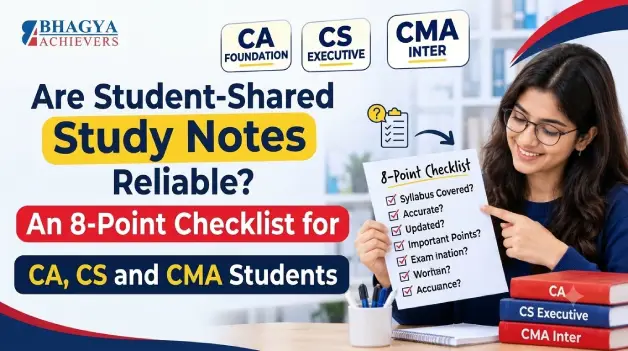
Are Student-Shared Study Notes Reliable? An 8-Point Checklist for CA, CS and CMA Students
Table of Contents
Why should you verify notes before using them?
Anyone can write notes, and even a good set can be outdated. A wrong definition or old provision, learned once, can cost marks in every paper where it appears. Verification takes a few minutes per chapter and protects your preparation.
Student-shared notes are popular because they are short, written in simple language and often shaped by someone who has recently faced the same paper. Those strengths are real, but they come with a risk: the author may have studied an earlier attempt, simplified a rule too far or copied a point without checking it. You usually cannot tell by reading alone, because wrong notes look just as neat as correct ones.
The 8-point checklist
- Right course and level. Confirm the notes are for your exact level, for example CS Executive and not Professional.
- Right syllabus and attempt. Check that the topics match the syllabus for your exam attempt.
- Recent amendments. Laws, standards and rules change. Look for the date or amendment reference, and compare with your main material.
- Accuracy of key terms. Verify definitions, section numbers, formulas and limits against your primary source.
- Complete logic. Good notes explain the reason behind a rule, not only the rule.
- Exam orientation. Notes should show how a topic is tested: format, marking pattern and common mistakes.
- Clear structure. Headings, tables and short points that you can revise quickly.
- Community validation. Ask in Study Doubts when something looks inconsistent, and read what other students flag in community posts.
You do not need to run all eight checks with equal depth on every page. A sensible approach is to spend more time on checks 2, 3 and 4 for subjects where rules change often, and more time on checks 5 and 6 for subjects that are mostly conceptual. If a set of notes fails the first two checks, stop and look for another set rather than trying to repair it.
What does the checklist look like on a real chapter?
Suppose you pick up notes on a chapter for your level. First, confirm the cover page names your course and level. Second, compare the list of topics with the syllabus for your attempt and tick off each heading. Third, pick five facts, such as two definitions, a section number, a limit and a format, and check each one against your prescribed material. If four or five match and the differences are small, the notes are probably safe to use. If several do not match, mark the set as unreliable and tell the community which points were wrong.
What if two sets of notes disagree?
Do not average them. Go back to the official or prescribed source for your attempt, note the correct version, and post the conflict so others can benefit. For CA result and marks related rules, see our guide on CA exam result and marks verification options.
The same rule applies when a friend, a video or a group message gives you a different version. The prescribed source for your attempt always wins, and writing down where you found the correct version helps you defend your answer later. Posting the conflict also helps the next student who opens the same notes.
What are the red flags in shared notes?
Be careful with notes that give rules without any reason, show no date or amendment reference, use section numbers that you cannot find in your main material, or promise that a few pages are "enough" to clear a paper. Also be cautious with notes that are heavily copied from another source without any added explanation. Good notes help you understand and recall; weak notes only repeat.
Where to find notes by course
FAQs
Q1. Are free notes enough to pass an exam?
Ans: Notes support revision, but passing depends on understanding the syllabus and practising answers. Pair them with a test series.
Q2. How do I know if notes are outdated?
Ans: Look for old section references, superseded standards or missing recent changes, then check exam updates.
Q3. Should I make my own notes instead?
Ans: Ideally, build your own short version from reliable notes. Blog 4 explains how.
Q4. Can I report a mistake I find in notes?
Ans: Raise it in the community doubts section with the chapter and the correct source.
Q5. How long does it take to verify a chapter?
Ans: For most chapters, a focused check of the syllabus, the amendments and five key facts takes only a few minutes, which is small compared with the marks a wrong point can cost.
Q6. Are notes from toppers always reliable?
Ans: Not automatically. A strong result shows the author studied well, but the notes can still be for a different attempt or contain small errors, so apply the same checklist
Recent Posts
-

CS Professional Test Series Strategy: Mastering Cas..
 21st November, 2026
-
How to Use Community Notes for CA Foundation, Inter..
26th November, 2026
-
Are Student-Shared Study Notes Reliable? An 8-Point..
26th November, 2026
-

How to Ask a Study Doubt Online and Get a Useful An..
26th November, 2026
-
How to Use Topic-Wise Notes and Community Updates f..
26th November, 2026
-
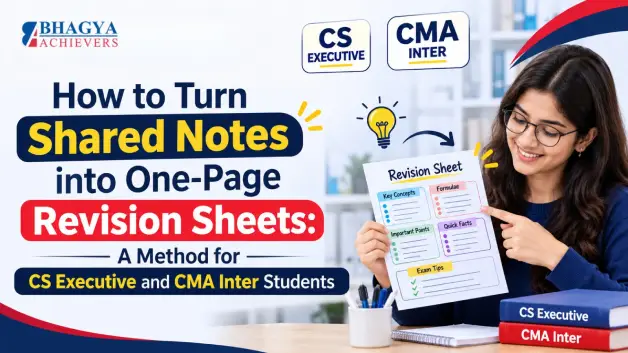
How to Turn Shared Notes into One-Page Revision She..
26th November, 2026
-
CS Executive Test Series: Module-wise and Full-Leng..
19th November, 2026
-

Best Test Series Combination for CA Inter: Chapter-..
19th November, 2026
-
Banking Awareness Revision System: Monthly Plan for..
16th November, 2026
-

Sectional Cut-Offs in Bank Prelims: How to Avoid Fa..
16th November, 2026
-
How to Write Answers for CMA Law and Ethics Papers..
13th November, 2026
-
CMA Inter and Final: Should You Attempt One Group o..
13th November, 2026
-
Passing Criteria Explained for CS Executive Subject..
11th November, 2026
-

Current Affairs Preparation Methods for Company Sec..
11th November, 2026
-
Online Examination Guidelines for CS Candidates..
11th November, 2026


