


 26th November, 2026
 Mentoring Program
 Bhagya Achievers
How to Ask a Study Doubt Online and Get a Useful Answer: A Guide for CA, CS and CMA Students
Table of Contents
Why do most doubts stay unanswered?
A post like "please explain this chapter" is too broad to answer. Helpers need context: which exam, which paper, which concept, and where you got stuck. Clear doubts get faster and more accurate replies.
There is also a quieter reason. Many students hesitate to post because they worry the question sounds basic. In practice, the doubts that help the most students are the basic ones, because many others have the same gap and are waiting for someone to ask. A clear, honest question is useful to the whole community, not only to you.
The 5-part doubt format
- Level and paper: "CMA Inter, Paper on Cost Accounting."
- Topic or chapter: the exact chapter name.
- The point that confuses you: write the line, formula or provision in your own words.
- What you already tried: your reasoning, the source you read, your answer.
- One clear question: "Why is this treated as X and not Y?"
Each part does a job. The level and paper tell helpers which syllabus and rules apply. The chapter lets them find the right material quickly. Writing the confusing point in your own words shows what you have understood, so the answer can start from there instead of repeating what you already know. Your attempt shows your reasoning, which is often where the real mistake sits. The single question keeps replies focused instead of turning into a long lecture.
Example of a weak and a strong doubt
|
Weak |
Strong |
|---|---|
|
"Explain CS Executive notes." |
"CS Executive, company law: I understand the meaning of the term, but I am unsure when it applies in practice. I read the notes and my main material, and both explain the definition only. Can someone give an example?" |
Notice what the strong version does: it names the course and subject, shows partial understanding, mentions what has already been read and asks for something specific, an example. A helper can answer it in two or three lines. The weak version forces a helper to ask three follow-up questions first, and many will simply move on.
Where to post and where to read
- Post your question on Study Doubts.
- Read earlier questions in Recent Posts; your doubt may already be answered.
- Check Recent Updates for announcements and exam-related news.
- Open the matching notes before asking: CA notes, CS notes, CMA notes.
What mistakes should you avoid when posting a doubt?
Avoid posting a photo of a full page with no explanation, asking for a complete chapter to be explained, or bundling five unrelated questions in one post. Avoid vague words like "tricky" or "confusing" without saying which line confuses you. Avoid deleting and reposting the same doubt, because replies and context get lost. If you realise your question was incomplete, add the missing details to the original post instead.
What should you do after you get an answer?
Verify it against your main material, write the corrected point in your recall sheet, and solve one question on it. For guided help beyond doubts, explore mentoring. If you are a new student, sign up to join the community.
Also say thank you and, if the answer worked, mention it. That small step tells helpers which explanations are useful and encourages them to keep answering. If the answer is incomplete, reply with a follow-up that is just as specific as your first post.
Doubts about exam rules
For rule-based questions, such as the CS online exam process, read our Online Examination Guidelines for CS Candidates first.
Rule-based doubts need extra care because rules and procedures change from one attempt to another. When you post one, mention the attempt or date you are asking about, and say where you read the rule. Replies should be checked against the latest official notice, since an answer that was right last year may no longer apply.
FAQs
Q1. What kind of doubts can I post?
Ans: Concept, application, numerical, answer-writing and exam-planning doubts for your course.
Q2. Should I post the same doubt in many places?
Ans: No. One clear post is easier to answer and track.
Q3. How long should a doubt be?
Ans: Short and specific: a few lines with the topic, the confusion and your attempt.
Q4. Can I trust every answer?
Ans: Treat answers as guidance and verify with your prescribed material.
Q5. What if nobody answers my doubt?
Ans: Check that your post has the level, chapter, the confusing point and your attempt. Improve it if anything is missing, check earlier posts for a similar question, and use mentoring if you need structured guidance.
Q6. Should I include the source of my confusion?
Ans: Yes. Mentioning whether the confusion comes from your notes, a book or a class makes it easier for others to find the exact point and to tell whether the sources disagree.
Recent Posts
-
CS Professional Test Series Strategy: Mastering Cas..
 21st November, 2026
-
How to Use Community Notes for CA Foundation, Inter..
26th November, 2026
-
Are Student-Shared Study Notes Reliable? An 8-Point..
26th November, 2026
-

How to Ask a Study Doubt Online and Get a Useful An..
26th November, 2026
-
How to Use Topic-Wise Notes and Community Updates f..
26th November, 2026
-
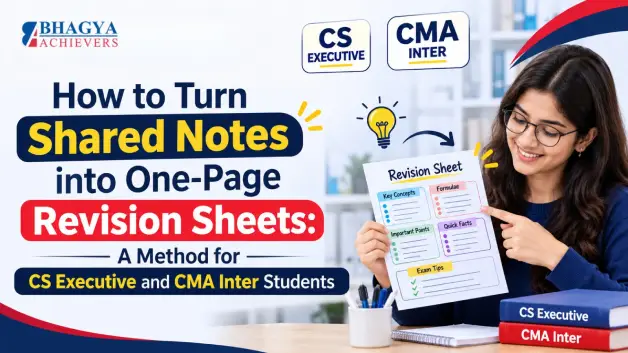
How to Turn Shared Notes into One-Page Revision She..
26th November, 2026
-
CS Executive Test Series: Module-wise and Full-Leng..
19th November, 2026
-

Best Test Series Combination for CA Inter: Chapter-..
19th November, 2026
-
Banking Awareness Revision System: Monthly Plan for..
16th November, 2026
-

Sectional Cut-Offs in Bank Prelims: How to Avoid Fa..
16th November, 2026
-
How to Write Answers for CMA Law and Ethics Papers..
13th November, 2026
-
CMA Inter and Final: Should You Attempt One Group o..
13th November, 2026
-
Passing Criteria Explained for CS Executive Subject..
11th November, 2026
-

Current Affairs Preparation Methods for Company Sec..
11th November, 2026
-
Online Examination Guidelines for CS Candidates..
11th November, 2026


