

 26th November, 2026
 Mentoring Program
 Bhagya Achievers
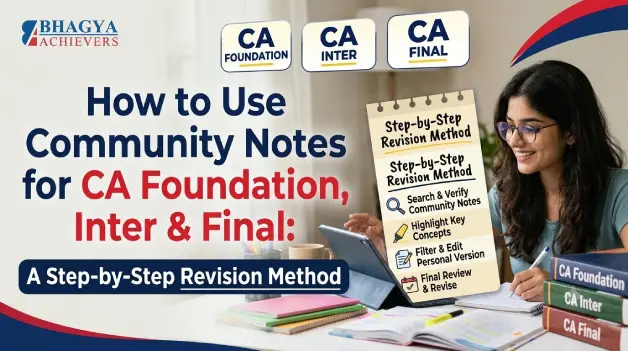
How to Use Community Notes for CA Foundation, Inter and Final: A Step-by-Step Revision Method
Table of Contents
Why do notes alone not improve CA marks?
Notes help you recall, but marks come from writing. A student who only reads notes feels prepared, then loses marks on presentation, time management and application. Notes work best when each reading is followed by a retrieval activity: writing the point from memory, solving a question, or explaining it to someone else.
This is why a student can read the same notes three times and still struggle with a ten-mark question. Reading builds familiarity, which feels like knowledge but is not the same as recall. In the exam hall nobody hands you the page. You must produce the definition, the provision or the working from memory, in a structured format, within a fixed time. Community notes are valuable because they compress a chapter into something quick to revise, but that only helps if you then practise retrieving and writing what the notes contain.
Step 1: Confirm the notes match your attempt syllabus
Before reading anything, check that the topic and amendments belong to your exam attempt. Our guide on how to verify your CA study material matches the applicable exam syllabus shows the checks to run.
Step 2: Open the notes page for your level
|
Your level |
Where to go |
Best use |
|---|---|---|
|
CA Foundation |
Quick concept revision, definitions, formats |
|
|
CA Inter |
Chapter summaries, comparison tables, group-wise revision |
|
|
CA Final |
Last-round revision, case-law and standards recall |
You can also browse all CA community notes or the latest uploads on Recent Notes.
Step 3: Compare notes with your main material
Read one chapter from your main material first. Then open the notes for the same chapter and mark only what is new or clearer. If a point differs, do not decide on your own; raise it as a doubt (see Step 6).
Keep a small "new points" list for each chapter. When the notes add something your main material did not stress, write it in one line and record where it came from. After a few chapters you will notice that notes usually add clarity, a comparison or a memory aid rather than entirely new content. If a note gives a number, section reference or limit that you cannot find in your main material, treat it as unverified until you have checked it.
Step 4: Convert notes into recall sheets
For each chapter, write three things on one page: key definitions, formulas or provisions, and two typical mistakes. This page is what you revise in the last week.
Write in your own words. Copying lines from the notes feels productive but trains your hand, not your memory. A good test is whether you could explain the sheet aloud without looking at it.
Step 5: Test what you revised
Revision is complete only after you have written answers under time pressure. Use the CA test series for your level and review where your recall sheet failed. If you are preparing several papers at once, read our guide to preparing for multiple CA exam papers together.
Step 6: Take unresolved points to the community
Post the point on Study Doubts with the chapter name and what you already tried. Follow Recent Updates for exam-related announcements.
How should you plan your revision rounds?
A simple pattern is three rounds. In round one, read the notes beside your main material and build the recall sheet. In round two, revise only from the recall sheet and attempt a few questions. In round three, a few days before the paper, scan the sheets, fix your mistakes list and attempt one timed paper. Spacing these rounds over weeks works better than repeating a chapter on consecutive days, because each return visit forces you to recall instead of simply re-reading.
What mistakes should you avoid when using community notes?
The most common mistake is collecting several sets of notes for one chapter and finishing none. Pick one reliable set per subject and revisit it. The second is skipping the syllabus check, which can leave you revising content from an older attempt. The third is leaving small doubts unresolved; a small gap in one chapter often reappears in another paper.
FAQs
Q1. Can community notes replace my coaching material or books?
Ans: No. They are best used for revision and quick recall alongside your main material or CA books.
Q2. When should I start using notes for revision?
Ans: After finishing the first reading of a chapter, so the notes reinforce what you have learned.
Q3. How many times should I revise one chapter?
Ans: Most students do better with several short, spaced revisions than one long one; tie each round to a test.
Q4. Where can I find notes for all CA levels?
Ans: On the CA community notes page.
Q5. Can I use notes close to the exam?
Ans: Yes, that is when they are most useful, provided you have already studied the chapter and have a recall sheet and a mistakes list to revise from.
Recent Posts
-

CS Professional Test Series Strategy: Mastering Cas..
 21st November, 2026
-
How to Use Community Notes for CA Foundation, Inter..
26th November, 2026
-

Are Student-Shared Study Notes Reliable? An 8-Point..
26th November, 2026
-

How to Ask a Study Doubt Online and Get a Useful An..
26th November, 2026
-
How to Use Topic-Wise Notes and Community Updates f..
26th November, 2026
-

How to Turn Shared Notes into One-Page Revision She..
26th November, 2026
-
CS Executive Test Series: Module-wise and Full-Leng..
19th November, 2026
-

Best Test Series Combination for CA Inter: Chapter-..
19th November, 2026
-
Banking Awareness Revision System: Monthly Plan for..
16th November, 2026
-

Sectional Cut-Offs in Bank Prelims: How to Avoid Fa..
16th November, 2026
-
How to Write Answers for CMA Law and Ethics Papers..
13th November, 2026
-

CMA Inter and Final: Should You Attempt One Group o..
13th November, 2026
-

Passing Criteria Explained for CS Executive Subject..
11th November, 2026
-

Current Affairs Preparation Methods for Company Sec..
11th November, 2026
-
Online Examination Guidelines for CS Candidates..
11th November, 2026


