

 26th November, 2026
 Bank Exams
 Bhagya Achievers
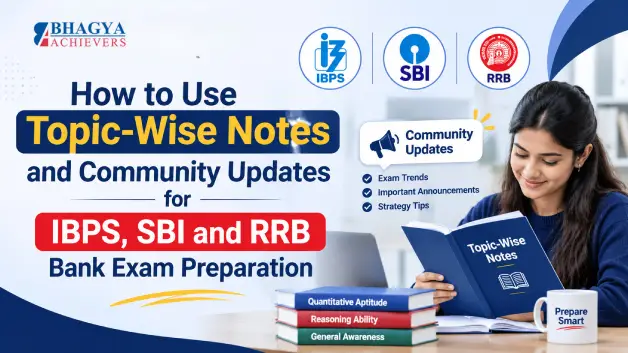
How to Use Topic-Wise Notes and Community Updates for IBPS, SBI and RRB Bank Exam Preparation
Table of Contents
Why combine notes, updates and mocks?
Bank exams test speed, accuracy and awareness across stages. Notes build recall, updates keep you aligned with the latest exam information, and mocks show where you lose time. Using only one leaves gaps.
The three also feed each other. A mock shows that you lose marks in a topic, so you open the notes for that topic. The notes bring you back to the right formula, and the next mock shows whether it helped. Community updates tell you whether anything about the exam pattern, dates or process has changed, so your practice stays relevant to the exam you will actually sit.
Which notes page should you open?
Start from the bank exam notes hub, then choose your exam:
- IBPS PO Notes
- SBI PO Notes
- SBI Clerk Notes
- IBPS Clerk Notes
- RRB PO Notes and RRB Clerk Notes
- RBI Assistant Notes
Open the page for the exact exam you are preparing for. Preliminary and main stages, and different posts, do not carry the same emphasis, so a general set of notes may waste time on topics your exam gives less weight.
A simple weekly routine
|
Day |
Activity |
|---|---|
|
Mon-Wed |
Revise two or three topics from notes; solve practice questions on each |
|
Thursday |
Take a topic-wise mock test |
|
Friday |
Analyse mistakes; update a short error list |
|
Saturday |
Take a full test from the bank exam test series |
|
Sunday |
Read exam updates and community updates; plan next week |
This routine is a template, not a rule. If you work or study during the day, you can move the topic revision to evenings and keep the full test on a weekend day. What matters is the order: revise, test, analyse, plan. Skipping the analysis day is the most common reason students take many tests but see little improvement.
How do you handle time pressure in quantitative sections?
Notes help with formulas and shortcuts, but question selection decides the score. Read Bank Exam Quantitative Aptitude: How to Choose the Right Questions Under Time Pressure.
In practice, scan the paper first and attempt questions you are confident about, then return to longer ones. Notes can help you here by keeping a short list of formulas, squares, cubes and common shortcuts that you can recall without effort, because every second saved on calculation is a second available for selection and checking.
Understand your exam before choosing notes
Different exams have different stages and roles. See IBPS PO vs SBI PO vs RBI Assistant: Difference in Exam Structure, Stages and Job Roles. For scores and normalisation, read Bank Exam Normalisation Explained.
Do this comparison before you spend weeks on notes. A student aiming for a clerk-level exam and another aiming for an officer-level exam may both open the same topic, but the depth, speed and selection strategy they need can be quite different.
Use the community for doubts and discussion
Post questions in Study Doubts, and follow community posts for preparation discussions. If you want structured guidance, explore bank exam mentoring.
How should you track your mock test results?
Keep a simple sheet with four columns: section, topic, attempted and correct. After each mock, record the topics where you lost marks and note why: a concept gap, a calculation slip, poor selection or lack of time. Over three or four tests, patterns appear. If most errors are concept gaps, go back to the notes. If they are calculation slips, practise speed drills. If they are selection errors, work on skipping low-value questions early.
What should you do in the final weeks before the exam?
In the last few weeks, reduce new material and strengthen what you already know. Revise your error list, take full tests at the same time of day as the real exam, and read exam updates carefully so that you are not surprised by dates or instructions. Keep a short list of formulas and facts for last-day revision, and do not start new topics at the last minute.
FAQs
Q1. Are notes enough for bank exam preparation?
Ans: Notes help revision, but regular mocks are needed to build speed and accuracy.
Q2. Where can I check exam notifications?
Ans: On the latest updates page and exam important dates.
Q3. Which notes should I use for a Clerk exam?
Ans: Open the notes page for your specific exam, such as SBI Clerk or IBPS Clerk, listed above.
Q4. How do I avoid wasting time on low-value topics?
Ans: Track your mock test results and prioritise topics where you lose the most marks.
Q5. How many mock tests should I take each week?
Ans: One topic-wise test and one full test, as in the routine above, is a practical start. Increase the number only if you can analyse each test properly, since analysis matters more than the count.
Q6. Can I study for two bank exams together?
Ans: Yes, because many topics overlap, but check the structure and stages of each exam and keep a separate list of the topics that differ.
Recent Posts
-
CS Professional Test Series Strategy: Mastering Cas..
 21st November, 2026
-
How to Use Community Notes for CA Foundation, Inter..
26th November, 2026
-
Are Student-Shared Study Notes Reliable? An 8-Point..
26th November, 2026
-

How to Ask a Study Doubt Online and Get a Useful An..
26th November, 2026
-
How to Use Topic-Wise Notes and Community Updates f..
26th November, 2026
-
How to Turn Shared Notes into One-Page Revision She..
26th November, 2026
-
CS Executive Test Series: Module-wise and Full-Leng..
19th November, 2026
-

Best Test Series Combination for CA Inter: Chapter-..
19th November, 2026
-
Banking Awareness Revision System: Monthly Plan for..
16th November, 2026
-

Sectional Cut-Offs in Bank Prelims: How to Avoid Fa..
16th November, 2026
-
How to Write Answers for CMA Law and Ethics Papers..
13th November, 2026
-
CMA Inter and Final: Should You Attempt One Group o..
13th November, 2026
-
Passing Criteria Explained for CS Executive Subject..
11th November, 2026
-
Current Affairs Preparation Methods for Company Sec..
11th November, 2026
-
Online Examination Guidelines for CS Candidates..
11th November, 2026


