


 27th January, 2026
 CMA- Cost Management Accounting
 Bhagya Achievers
From Syllabus to Scores: An Advanced Mentoring-Led Approach to Crack CMA Inter & Final
Table of Contents
Cracking CMA Inter or CMA Final is not about how many hours you study or how many questions you solve. It’s about how you move from syllabus to scores – and honestly, most students get stuck in between.
Every year, thousands of CMA students start preparing with full energy.
And every year, many of them lose confidence not because they are weak, but because their preparation lacks direction and mentoring.
Let’s first understand where exactly CMA students struggle, and then we will talk about how Bhagya Achievers advanced mentor – led approach bridges the gap between hard work and actual scores.
The First Big Mistake: Wrong Entry Point into the Syllabus
Many CMA students start their CMA preparation in one of these two extreme ways:
CASE 1: Starting with difficult Concepts first
Students think: “Let me finish the toughest chapters first”
So they jump straight into complex chapters – strategic models, advanced costing cases, risk management frameworks, or valuation numericals.
What happens?
- Concepts don’t click immediately
- Progress feels slow
- Self-doubt creeps in
- Within few weeks motivation drops
After all this they start questioning their capability without knowing that the main problem is approach not intelligence.
CASE 2: Only Preparing Easy Topics First
Some CMA students do the opposite. They start preparing easy concepts first.
But Later:
- All difficult topics pile up together
- Time pressure increases
- Build up Mental resistance
- Feel overwhelmed handling all the tough concepts at once
Result? Panic, Procrastination, Incomplete syllabus and Failure.
What’s missing in both cases?
A mentor-guided sequencing strategy – deciding what to study, when, and how deep.
Are you repeating the same mistake? Click and Fix your preparation approach now
- No Short Notes = No Control Over Revision
Another main problem while preparing for the CMA exam is not making short summary notes.
Students read modules, watch classes, solve questions – but they don’t:
- Compress concepts
- Write formulas in one place
- Note examiner- friendly keywords
- Create revision-ready material
So when exams approach:
- Revision becomes re-reading everything
- Important points get mixed with low – value content
- Confidence remains low despite long hours
Short notes are not optional – they are your exam time weapon.
Without them, revision is slow and stressful.
- Quantity Over Quality: The Most common Mistake
Many students proudly say:
“Maine 100 Questions Attempt Kiye”
Sounds Productive, Right?
But when marks don’t improve, they feel lost.
The problem?
- They attempt 100 questions
- But don’t analyze even 10 properly
- Mistakes repeat again and again
- Same concepts fetch low marks every test
One well – analysed question, reattempted after feedback, taught more than 10 blindly attempted ones.
Advanced CMA preparation is not about how many questions you attempt, but:
- Did you understand why marks were cut?
- Did you fix presentation errors?
- Did you rewrite the answer better next time?
This will not happen without mentor intervention.
- No ABC Analysis before exam = Wasted Effort
If a chapter has 50 questions, most students attempt all 50 questions before CMA Inter and Final exams.
What they don’t do:
-
ABC analysis of questions
- Identify high-frequency exam areas
- Prioritize scoring concepts
As a result:
-
Time is wasted
- Revision becomes heavy
- Important areas don’t get enough attention
Mentor – led ABC analysis helps student focus on:
-
A Topics: Must – do, high scoring
- B Topics: Attempt if time permits
- C Topics: Low Priority or selective study
This single step can improve scores dramatically.
-
Ignoring Format = Losing Easy Marks
Many CMA students know the concepts but still lose marks because they don’t practice exam formats before the exam. During Preparation, focus often stays on reading and understanding – but format practice is ignored.
In the exam hall, this becomes a real problem. Students struggle with:
- Structuring answers under time pressure
- Deciding correct headings and sub headings
- Presenting working notes properly
- Writing case study answers in an examiner friendly flow
That’s how easy, scoring marks are lost – not due to lack of knowledge, but lack of format practice.
Avoid format mistakes before the exam with our CMA Test Series
SO WHAT ACTUALLY WORKS?
The Advance Mentor – Led Approach
An Advance mentor-led CMA Preparation approach is designed to convert effort into marks.
Here’s how it changes everything:
-
Removes Confusion About “What to study First”
CMA students often struggle with whether to start with easy chapters or difficult ones.
Mentors solve this by:
-
Providing customized study plan for CMA Inter and CMA Final
-
Mix conceptual clarity along with scoring concepts
-
Helps to overcome early demotivation and late concept overload
Result: CMA Students move forward with clarity, not confusion.
-
Builds Strong Conceptual Foundation
Mentors focus on:
-
Concept clarity instead of rote memorization
-
Interlinking topics across various chapters
-
Practical application of theory
This is crucial for CMA exams, which not only test application but also test interpretation.
Result: Answers become structured, logical, and examiner – friendly.
Join our mentor-led program and see the difference in your preparation approach
-
Helps to make and Use Short Notes
Instead of reading bulky notes, mentors guide students to:
-
Make small and concise summary notes
-
Highlight exam oriented keywords
-
How to use community notes?
-
Make quick revision notes for last days
Result: Faster revision, better recall, and reduced exam stress.
Click here to get free notes—curated for CMA exam success
-
Shifts Focus From Quantity to Quality Practice
Most CMA students attempt too many questions without learning from mistakes. Mentor- led preparation ensures:
-
Fewer but effective question attempts
-
Detailed analysis of mistakes
-
Re-attempting answers after feedback
Result: Continuous improvement not only in answer quality but also in marks.
-
Enables ABC Analysis & Smart Topic Prioritization
Before CMA Inter and CMA Final exam, mentors help students:
-
Identify high-weightage and scoring topics
-
Avoid unnecessary overload
-
Give more focus to that areas that repeated frequently and maximize marks
Result: Smart Preparation under time pressure
-
Help students in Exam Formats & Presentation
Many students lose marks even after knowing answers. Mentors help students in:
-
Proper formats and working notes
-
Presentation
-
Use of heading, diagrams, and summaries
Result: No loss of easy marks due to presentation and formats
-
Develops Exam – time Strategy & Confidence
Mentor guidance includes:
-
Time management in the exam hall
-
Question selection strategy
-
Handling pressure and uncertainty
Result: Calm, confident, and controlled exam performance.
-
Tracks Progress & Prevents Last – minute preparation
Through continuous testing and review, mentors:
-
Track students daily progress
-
Analyze weak areas early
-
Helps to make strategy to attempt questions before exams
One click is all it takes to track your progress
-
Provides Emotional & Motivational Support
CMA Preparation is long and tough. Mentors help CMA Final and Inter students:
-
To stay consistent by giving daily small targets during burnout and stress
-
By providing motivation and emotional support through daily follow ups
-
Believe in their preparation
-
Try not to quit CMA course
Result: Students feel motivated, supported and confident.
From Syllabus Completion to Score Conversion
Most students complete syllabus
Very few convert it into marks
The difference is mentoring.
When preparation is:
-
Planned
-
Reviewed
-
Corrected
-
Directed
Confidence replaces confusion
Effort turns into results.
Final Thoughts
CMA Inter & CMA Final are not impossible
They are unguided for many students.
With the help of right mentoring:
-
You study smarter
-
You avoid common traps
-
You move step by step from syllabus to scores
Because in CMA, directions matter more than speed.
Join Bhagya Achievers—one solution for all your preparation problems
FAQs
Ques: Is this approach useful if I am already studying on my own?
Ans: yes, Many CMA self-study students study hard but still lose marks due to lack of direction. A mentor helps you study in the right order, avoid common mistakes and focus on scoring areas.
Ques: When should a CMA student start ABC analysis and revision planning?
Ans: ABC analysis and revision planning should start along with preparation, not after syllabus completion. Early planning makes sure smart study, better retention, and reduced pressure before exams.
Ques: Should CMA Inter and CMA Final students attempt all questions from every chapter?
Ans: No, attempting all questions is not smart preparation. A mentor helps students analyze the most important questions that cover maximum concepts and exam weightage.
Ques: Why do students feel confident during preparation but underperform in exams?
Ans: Because preparation is often activity based, not outcome – based. Students read, solve questions, and complete chapters but don’t align their preparation with exam expectations, formats, and marking patterns, which mentors focus on.
Ques: Why do CMA students struggle to revise the syllabus multiple times?
Ans: Because revision is not planned from Day 1. Without summary notes, priority lists, and revision cycles, students try to revise the entire syllabus again, which becomes mentally and physically exhausting.
Ques: Why do some students complete syllabus early but still panic before exams?
Ans: Early syllabus completion without revision strategy and exam orientation creates anxiety. Mentoring make sure that syllabus completion is followed by structured revision and consolidation.
Also Check:
- Advanced CMA Study Strategy: Using Community Notes, Revision Cycles & Mentor Feedback
- CMA Foundation, Intermediate & Final: Best Community Notes to Use
- How to Prepare Effective Notes for CMA for Maximum Retention?
- CMA Coaching vs Self-Study – Which is the Best Path for Exam Success?
- How to Master Direct Tax & International Taxation for CMA Final?
- Career Opportunities after CMA India – Sectors, Roles & Salaries
- Importance & Role of Mock Tests in CMA Exam Preparation
- Top Resources and Books for CMA Students Preparing for ICMAI Exams
- Can I Crack CMA by Self-Study?
- How to clear the CMA Final exam in the first attempt?
- How to clear CMA Inter in First Attempt?
- Bhagya Achievers test series vs Other Coaching Platforms: What Sets Us Apart
Recent Posts
-

How to Prepare for ICSI Open Book Examinations: Res..
 16th October, 2026
-
CS Professional Drafting Questions: A Practical Gui..
16th October, 2026
-

CS Executive Company Law Case Studies: How to Ident..
16th October, 2026
-
CA Exam Preparation After Completing the Syllabus: ..
6th October, 2026
-
ICAI RTP, MTP and Previous Year Papers: How to Use ..
6th October, 2026
-
CA Inter Taxation: How to Prepare for Questions Inv..
6th October, 2026
-
CA Exam Answer Presentation: How to Structure Your ..
6th October, 2026
-

Test Series vs Self-Study: What Actually Improves Y..
1st October, 2026
-
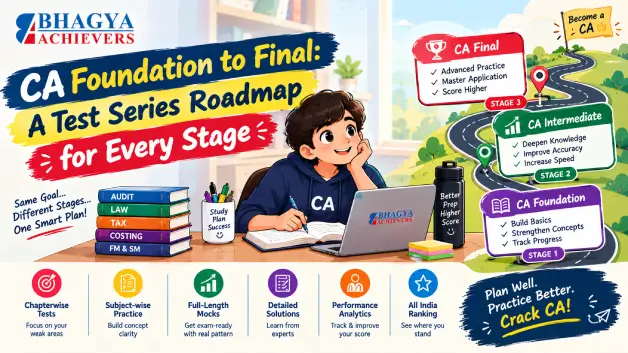
CA Foundation to Final: A Test Series Roadmap for E..
30th September, 2026
-

How to Use Mock Test Results to Boost Your CA Score..
30th September, 2026
-

5 Reasons Toppers Swear by Test Series Before CA Ex..
26th September, 2026
-

Why CA Final Online Test Series Is a Game-Changer f..
25th September, 2026
-

CA Final Now Twice a Year (May & November): How..
22nd September, 2026
-

Why Your Bank Exam Score Isn’t Improving Despite ..
22nd September, 2026
-

Negative Marking in Bank Exams: How Test Series Pra..
20th September, 2026


